


Putting chinese diplomacy into frame
A look into the past of a political photographer who managed to get up close and personal with some of the world's most high profile leaders
Xu Genshun may already be 67 this year, but the memories of his profession as a political photographer are still as intact as the poignant images he once shot.
For example, he still fondly remembers the moments when former Russian leader Boris Yeltsin suddenly stepped out of his car to shake hands with Shanghai residents and the childlike smile of the former prime minister of Canada Jean Chretien as he rode a Phoenix bicycle through a busy street in the city.
"My photography approach was to tell the hidden stories in history using close-ups of facial expressions, attire details and body language," said Xu, who has throughout his illustrious 28-year-career photographed more than 800 visiting world leaders and other important guests.
|
From left: Former Russian leader Boris Yeltsin shakes hands with residents during his visit to Shanghai; former prime minister of Canada Jean Chretien rides a Phoenix bicycle along a busy street in Shanghai. |
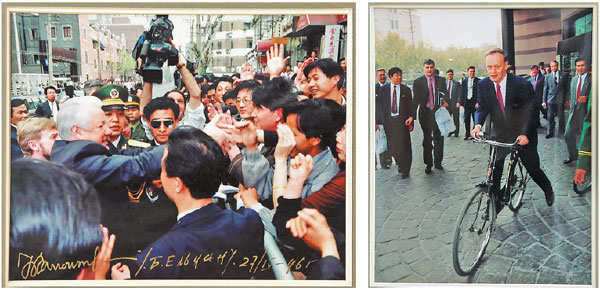
"Those photos captured the dramatic changes taking place in Shanghai back during those times and were a way of recording how China's diplomatic relationships with other countries developed through years."
Born in 1949 when the People's Republic of China was founded, Xu went through the "cultural revolution" (1966-76) after graduating from secondary school and was assigned to the Shanghai Machinery Factory of Mining and Metallurgy.
He later studied journalism in Jiangxi University before becoming a professor at the Shanghai University of Engineering Science. His accidental foray into political photography only began when he started work at Jin Jiang Tower, the first five-star hotel in China run by Chinese. Jin Jiang Tower was at that time the hotel of choice of many world leaders during their visits to Shanghai.
"The monthly salary of a professor was only 156 yuan ($23), which was not enough for me to support my family. I was introduced to Jin Jiang Tower by chance and took up the role of an administration executive officer who was in charge of reception services for foreign leaders," said Xu of his decision to switch jobs.
Xu soon found himself attending a host of foreign affairs events and having to take photos of dignitaries to commemorate the occasion. Because of his role in the hotel, Xu said that he managed to capture images that were different from what was normally seen in the media.
"Being given such opportunities allowed me to record candid moments of many presidents and premiers. The images I managed to capture were quite different from the stereotypical serious and set-up shots printed in newspapers or seen on television," said Xu.
Excited by the fact that he had access to high profile individuals who could influence China's development and matters of the world, Xu was determined to take things a step further - get even closer to his subjects in order to capture the more intimate moments. He also wanted their autographs.
"I made it a point to appear in front of the leaders' bodyguards at every chance because I wanted them to be familiar with my face. I also made sure that I spoke with key Chinese leaders when these foreign bodyguards were watching so that they would know I was not a threat," said Xu.
His methods worked, and it even led him to precious encounters that few in this world could only dream of. After all, this was exactly how he managed to get up close and personal with the late Cuban leader Fidel Castro in December 1995. Castro even indulged Xu with a chat and gave him a cigar.
Part of his job also involved taking pictures of the wives of political leaders and Xu recalled how he was assigned to capture a group photo for a number of first ladies in Shanghai's Xintiandi area during the APEC summit many years ago. Xu added that the women were duly impressed with the speed at which the photos were printed and presented as gifts within just half an hour, a feat made possible only with the help of government staff.
"In my eyes, there is no group of women that can be on par with first ladies. They are extraordinarily elegant and beautiful," said Xu.
"The style I used to record the interactions between the leaders and their wives are different from the usual. I tried to capture those intimate moments where the leaders and their ladies were in a relaxed setting, such as close-ups of them whispering and making eye contact."
In 2007, Xu started sorting out the pictures he had taken to create a book titled State Guests in Shanghai and First Ladies in Shanghai which was published a year later. Han Zheng, former mayor of Shanghai, wrote the preface.
"The year of 2007 was an important year for China because of the upcoming 2008 Beijing Olympics and the 2010 Shanghai Expo. I wanted the book to show Chinese people the results of Chinese diplomacy over the last few decades," said Xu.
In addition to photos, his collection also contains images of the numerous menus that political leaders received during their dining receptions in Jin Jiang Tower, as well as commemorative envelopes and stamps bearing their autographs.
"I am planning to publish several editions of the menus that I have collected. I think cuisine is an integral part of Chinese culture and the type of cuisine served to foreign leaders reflected the economic and living standards of China at that time," said Xu.
"I also hope that I can cooperate with chefs in hotels or restaurants to recreate the dishes on the menus for the public."
Till today, Xu spends most of the day working in his 100-square-meter studio sorting volumes of documents and old photos that span 10 large tailor-made leather suitcases and several shelves. His collection includes envelopes autographed by over 400 world leaders, thousands of photographs of these leaders and their wives, and 280 dining menus.
"These photos I have shot, the menus for the foreign guests and the signatures I have collected, they are all part of history - they are the witnesses to the development of Chinese diplomacy and the rise of Shanghai."
Cheng Si contributed to this story.
















