


New child policy increases births
The universal second-child policy implemented early last year was a major factor in raising the number of births in China to 17.86 million last year, an increase of 7.9 percent and the highest annual number since 2000, according to the top health authority.
The number of newborns increased by 1.31 million compared with 2015.
The portion of the births to couples who already had at least one child rose quickly to at least 45 percent last year, Yang Wenzhuang, a division director of the National Health and Family Planning Commission, said at a news conference on Jan 22. The proportion was around 30 percent before 2013.
"It demonstrates that the universal second-child policy came in time and worked effectively," Yang said.
|
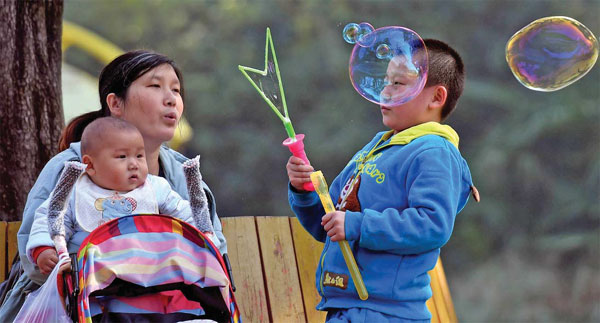
Second-child policy implemented early last year was a major factor in raising the number of births in China to 17.86 million last year. Provided to China Daily |
"Some regions, mostly large cities in eastern areas, began recording second children as comprising more than half of local newborns," he added.
Yang expected that by 2020, the number of new births each year would stand between 17 and 20 million in China, citing expert estimates.
Ma Xiaowei, deputy director of the commission, said recently a baby boom triggered largely by the new policy would probably come within the next two years.
For that, the commission plans to add 140,000 more maternity health workers in the coming years, he said.
The top decision-makers intensified efforts in late 2013 to adjust birth policies in place for three decades that limited most couples to just one child, hoping to address major demographic challenges such as an aging population and a looming labor shortage.
Starting in early 2014, couples of which one person was an only child could have a second child. The universal second-child policy was implemented at the start of 2016.
"The long-term effect of the universal second-child policy is very helpful to China's sustainable development," says Yuan Xin, a professor of population studies at Nankai University in Tianjin.
By 2050, the policy is expected to bring about an extra 30 million working-age people and reduce the nation's aging rate by 2 percent, commission projections show.
But matching policies have not yet been refined to provide good support for couples willing to have more than one child, particularly in terms of maternity education and health services, Yang conceded.
A 2015 survey by the commission found nearly 75 percent of respondents were reluctant to have a second baby, largely due to economic burdens.
Other major concerns are age, parents' career development and a lack of caregivers, it showed. Yuan suggested the government introduce support measures like favorable tax policies, prolonged maternity leave and education for families with two children.
shanjuan@chinadaily.com.cn
















