China could withstand a trade war
Nation has the resources to survive Trump's threatened onslaught and create prosperity internally
In the Chinese press, offline and online, business commentators are nowadays all talking about the same thing: the coming trade war with the United States.
But whether there will be a full-scale trade war is up to Donald Trump, because that's what he said he wanted. What the Chinese should do is not just talk, explaining that trade war isn't a good thing. They can do many things, starting right now, to make the economy less vulnerable to outside influences and stronger against imminent trade war attacks.
No matter on how many fronts and how seemingly powerful the trade war is, it comes from the outside after all. How much resistance an economy can mobilize depends primarily on internal factors.
Having long foreseen the unsustainability of its export-driven growth since the 1990s, China has, beginning almost 10 years ago, been gradually reducing its dependence on foreign trade.
Not only has the total volume of its exports been in decline, the ratio between export and total GDP fell from 37 percent 10 years ago to around 20 percent, according to the World Bank. Although it is higher than the US level, it is lower than that of many trading nations in Asia and Europe.
Admittedly, in volume, the figure for China's export of goods to the US is still much larger than that for imports, registered as $482 billion versus $116 billion by the Office of the US Trade Representative. But a large proportion of it was made-for-US consumer brands.
Should US businesses discard the production they have partnered with in China and ship the $300 billion-plus-worth of business entirely home, that would be more than 2 trillion yuan ($308.6 billion; 208.6 billion euros; 184.9 billion), as compared with China's total GDP of some 74 trillion yuan in 2016, or less than 3 percent of the latter.
It may not be extremely hard for China to redirect that amount of productivity to other markets, domestic and foreign. At least mathematically, Chinese society has become different from the way it was 20 years ago. A rise in the general income level in coastal cities should have created enough middle class consumers who want to spend more, evidence of which is also seen in data for the spending of Chinese tourists abroad.
With smart management, China may better utilize that new potential of its society, to provide its middle class consumers with goods of better quality and better services.
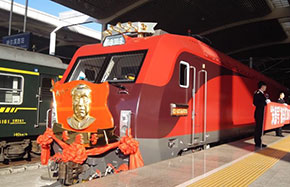
One handy example is the rapid expansion of the high-speed rail network.
At the beginning of the rail modernization program, many people doubted its commercial viability. In fact, many of the long, hugely expensive railways cannot be expected to generate a profit in a just two to three years.
But the nation's consumer behavior has changed quickly, with an increasing number of people willing to travel for holidays and weekends on the speedy and decent train rides to cities other than their home towns.
In 2015, by serving 4 billion visitors, the nation generated 4 trillion yuan in tourist revenue, a much larger amount than its merchandise trade surplus with the US.
In 2017, some major high-speed railways were completed to link the more developed coastal cities with the scenic towns in the mountainous West China. With good security protection and more entrepreneurial initiatives, China's "high-speed rail economy" alone can generate enough to compare with the GDP of a medium-sized nation.
So in the face of Trump's statements, the best defense China can have is to never get distracted by his attacks and deceits and be steadfast in pursuing its own economic reform. This is the most effective way China can win the future trade war.
The government should do a better job not only in investing in large infrastructure, but also in protecting small enterprises and private initiatives - with good laws and policy terms. It should start acting now.
The author is editor-at-large of China Daily.