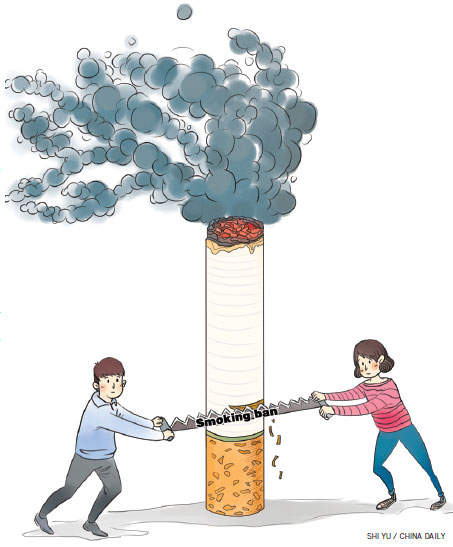
Tobacco lobby holding back smoking ban
On Wednesday, Shanghai becomes the latest municipality in China, following Beijing and Shenzhen, to launch a 100 percent smoke-free policy in public places and work spaces. Some 60 million people - more than the population of many countries - living in these cities can now enjoy smoke-free public places.
While we congratulate Shanghai on joining Beijing and Shenzhen as global leaders in tobacco control, we must also ask: How is it that only three cities in China have adopted comprehensive smoke-free policies? What is standing in the way of the rest of the 1.3 billion citizens having the right to smoke-free indoor air in their workplaces and factories, and in restaurants and shopping areas?
President Xi Jinping has announced his vision for China's future. First, he announced the Chinese Dream; then he called for the Chinese economy to reinvent itself, led by industrial innovation; and last summer, he announced his Health China 2030 initiative, a bold declaration that made public health a precondition for all future economic and social development.
As evidenced in this remarkable series of policy announcements, Xi's vision for China is one in which economic growth enhances, rather than sacrifices, individual well-being.
Unfortunately, there remains a glaring obstacle to realizing the Chinese Dream and Healthy China 2030 vision - an obstacle which has resisted the considerable efforts of China's public health authorities, advocates and citizens: the tobacco economy.
Tobacco represents an economy of the past. China's tobacco companies do not fit the vision of an economy driven by innovative, value-added manufacturing and a strong service sector. Its very reliance on Chinese smokers undermines efforts to build a healthy China by 2030.
We celebrate the smoke-free laws in Beijing, Shanghai and Shenzhen. But they are among the wealthiest cities in China, which raises the question of inequality. Smoke-free indoor air should not be a luxury for the wealthy, rather an entitlement for all Chinese citizens who are working hard to realize the Chinese Dream.
Why is this not happening? The reason is largely because of the short-sighted economic interests that are not aligned with the President's vision.
The small but successful tobacco tax adopted in 2015, which reduced smoking and increased government revenues, should be drastically increased so that the tobacco companies pay more tax and farmers start growing alternative crops.
Instead, there is continued resistance to further tobacco taxes and stronger advertising restrictions. Most concerning is that progress has all but stopped on a national smoke-free law.
To those who doubt whether rural governments are capable of implementing a comprehensive smoke-free law, I would point to the hundreds of millions of people China pulled out of poverty in three decades - a much tougher implementation challenge, achieved through strong government leadership and coordinated action at all levels.
Xi's vision for China's future is clear. The country's leadership should pass comprehensive legislation against tobacco to ensure all Chinese citizens, not just those in the wealthiest cities, can breathe smoke-free air indoors.
Local leaders like those in Shanghai are taking bold decisions to ensure the health of citizens. And even in the absence of national legislation, they are breathing new life into the Chinese Dream to make Xi's Healthy China 2030 vision a reality and relegate the tobacco economy to a place it deserves - in the past.
The author is WHO representative in China.