


More China-made robot parts planned
Domestic production will save on costs, break foreign dominance
China aims to break foreign dominance in the manufacture of core robot components in one to two years, as the world's largest industrial robot market makes progress in producing reliable speed reducers, servomotors and control panels, says one of the experts involved in drafting the Made in China 2025 strategy.
The parts are the three basic building blocks of sophisticated automated machines and, if all are imported, they account for about 70 percent of a domestic robot's production cost.
"We aim to increase the market share of homegrown servomotors, speed reducers and control panels in China to 30 percent by 2018 or 2019," says Qu Xianming, an expert with the National Manufacturing Strategy Advisory Committee, which advises the government on plans to upgrade the manufacturing sector.
|
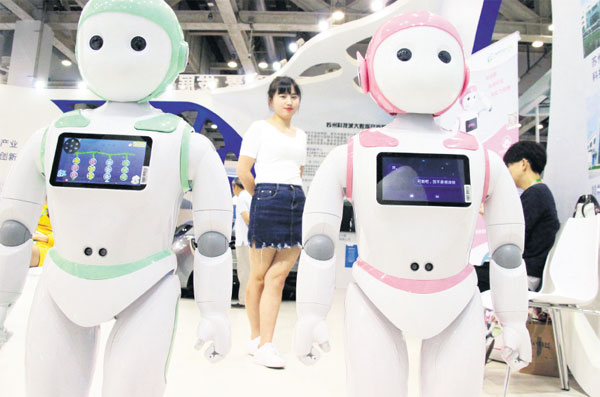
Robots at an electronic products exhibition in Suzhou, Jiangsu province, in May. Wang Jiankang / For China Daily |
By then, these indigenous components could be of high enough quality to be exported to foreign countries, Qu said in an exclusive interview with China Daily.
Once the target is met, there will be a strong foundation for Chinese parts makers to expand their presence, he says.
Currently, most of these parts are imported from Japan, Europe and the United States, which has markedly increased domestic robot makers' production costs and weighed down their competition with foreign rivals.
"Domestic players have to spend four times as much as their foreign counterparts to buy speed reducers and twice as much for a servomotor," according to a white paper released last year by the China Center for Information Industry Development, a research agency affiliated with the Ministry of Industry and Information Technology.
China overtook Japan as the world's largest market for industrial robots in 2013. Last year, it installed 90,000 new industrial robots. That's one-third of the world total and 30 percent more than the year before, data from the International Federation of Robotics shows.
The country plans to boost its annual production capacity of industrial robots to 100,000 in 2020 from 72,400 in 2016, signaling the growing demand for essential components.
"To mass-produce core robot parts is a flagship project of the Made in China 2025 strategy. Domestic players are making leaps forward," Qu says.
Shaanxi Qinchuan Machinery Development Co, for instance, can produce 10,000 units of cycloidal speed reducers a year. Cycloidal speed reducers allow robots to move with greater accuracy. The company is building a factory that will have an annual output capacity of 60,000 units when completed by the end of 2018.
Nantong Zhenkang Machinery Co, another maker of cycloidal speed reducers, is working on production lines that can make 50,000 units a year. "Once the two projects are completed, they can meet 30 to 40 percent of the domestic demand," Qu says.
Chinese players also are scrambling to develop in-house control panels, which demand many tailor made features, he adds.
Wang Jiegao, chief engineer of Estun Automation and general manager of subsidiary Estun Robotics Co, says the company can produce more than 100,000 servomotors a year, most of which go to high-end numerical control machines, so the supply to robots is still limited.
"Numerical control machines demand higher accuracy, but robots are more sophisticated," Wang says, adding that the company still needs to buy speed reducers from foreign companies.
"It is highly likely that China will meet the 30 percent market share target, which can greatly lower the production costs," he says.
Rodney Brooks, founder and chairman of Rethink Robotics, said in an earlier interview with China Daily that the Chinese robotics market is booming. The rising labor cost and shrinking labor pool will further drive the demand for industrial robots in the country, according to Brooks.
















