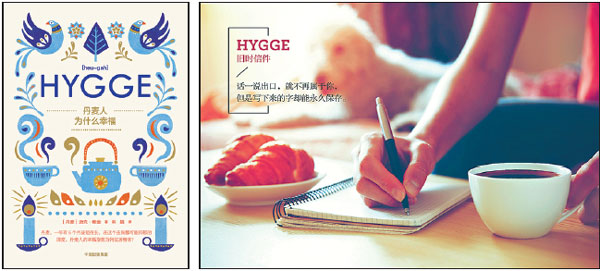
Danish book on pursuit of happiness now out in Chinese
Japanese self-help writer Yamashita Hideko's books on danshari were popular in China in the past. The concept encourages people to get rid of junk, both physical and mental.
"But after clearing up your house and your heart, you have to fill your soul with something, otherwise you will feel empty inside," says Li Jingyuan, deputy editor-in-chief of Citic Publishing Group. "So that's why we have published the Chinese version of The Little Book of Hygge: Danish Secrets to Happy Living."
The Chinese version was printed in May.
"Many Chinese live busy lives, with a lot of daily pressure. They don't feel happy," Li says.
Maybe by reading this book to learn about why Demark has topped the list of the happiest countries in the world, as announced by the United Nations for four consecutive years, Chinese people can also get the secret of hygge, Li said at the book launch ceremony at the Danish embassy in Beijing on Tuesday.
In recent years, with the popularity of books about Danish hygge, such as The Book of Hygge and The Year of Living Danishly: Uncovering the Secrets of the World's Happiest Country, hygge has become a trendy lifestyle philosophy to pursue happiness, just like danshari several years ago.
"The reason why there is so much global interest in hygee, Denmark and happiness these years is because of the global feeling that a lot of countries have got richer without their people getting happy. So, people are looking for inspiration from successful cases. More and more people are looking into Denmark for inspiration for quality life," says Meik Wiking, the author of The Little Book of Hygge, via video from Copenhagen at the book launch.
Although dictionary publisher Collins listed the word hygge among its top 10 words of last year, and the Oxford English Dictionary has included it as an entry, there is still not an English or Chinese counterpart that can express the meaning accurately.
Hygge, a noun, an adjective or a verb in Danish, means "cozy intimacy" that one shares with one's family and friends.
In the book, Wiking, who is also the chief executive of the Happiness Research Institute in Copenhagen, gives a typical hygge occasion: He and his friends were spending a weekend in an old cabin one winter. It was the shortest day of the year. After a long walk outside, they arrived at the cabin, put on warm sweaters and sat near the fireplace, each holding a cup of hot drink, and talked until everyone fell asleep. The silence was enhanced by the sounds of bubbling beef stew and crackling firewood.
If the weather outside turned worse, with the wind howling and the rain pouring, it would have been a more hygge time for them, he writes in the book.
Hygge, Wiking says, indicates a kind of atmosphere and experience - hanging out with loved ones and feeling a sense of belonging.
"(The lifestyle of hygge) is the pursuit of happiness, something inexpensive and accessible," he says via video.
Wiking gives 10 key words to describe hygge: atmosphere (dim the lights), presence (turn off the phones and be attentive), pleasure (coffee, chocolate, cake or candy), equality (share tasks), gratitude, harmony (it's not a competition, so no need to brag), comfort (it's all about relaxation), truce (talk about politics another day), togetherness and shelter.
"The best predictor of whether we are happy or not is our social relationships," Wiking writes.
Those with high-quality social relationships tend to be the happiest, he says.
yangyangs@chinadaily.com.cn
|
The Chinese edition of The Little Book of Hygge: Danish Secrets to Happy Living was printed in May. The lifestyle concept of hygge is gaining popularity among Chinese readers.Photos Provided To China Daily |