


Renminbi's global push is forging ahead
With new drivers, China's currency enters another stage of internationalization with an ever stronger role in financial transactions
After successfully navigating the 2008-09 global financial crisis and regaining a strong sense of economic confidence, China embarked on an ambitious project to internationalize its currency, the renminbi or RMB.
China's experiment in this regard is unique in that, contrary to the experience of other international currencies, such as the US dollar, the British pound or the Japanese yen, efforts to internationalize the RMB are proceeding ahead of the full opening (or convertibility) of the capital account.
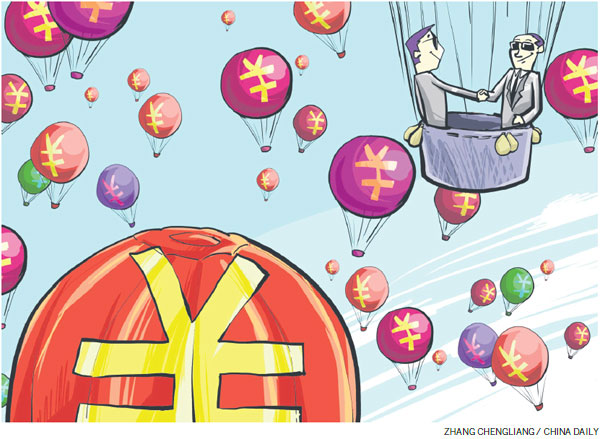
Starting with a pilot program in 2009, which allowed importers and exporters to use RMB as a settlement currency in their trade with China, the authorities' efforts with respect to the RMB internationalization have led to a stellar rise of the "redback" in the global monetary system in less than a decade. The RMB has now become something a global buzzword: The bulk of exports and imports between China and its trader partners is settled in the RMB rather than the other global currencies used previously; a number of international financial centers, including Hong Kong, London and Singapore, are wooing RMB-related businesses to solidify their positions as offshore RMB centers; and more important, the International Monetary Fund included the RMB in its currency basket of Special Drawing Rights in 2015, marking its international acceptance as a "freely usable" currency.
Despite the significant progress achieved so far, the RMB still has a long way to go before it becomes a global currency in a real sense. Moreover, a couple of important drivers behind its fast rise in the international arena now seem to have lost their steam. For example, RMB denominated trade amounted to 29.4 percent of China's total trade in 2015. However, the room for further pushing up this share is limited due to the large share of commodity and processing trade. Historically, global commodity trade is invoiced and settled in the US dollars, which cannot be replaced by the RMB anytime soon. In the meantime, processing transactions generally include two legs: one is import and one is export. To reduce the risk of currency mismatch, the parties in processing trade tend to settle these two legs with the same currency, forming another obstacle to increasing the share of RMB - settled transactions in China's total trade. All in all, expanding the share of the RMB settlement in trade will no longer push forward RMB internationalization as fast as it did before.
The other slowed driver of the RMB internationalization is the seriously weakened expectation of RMB appreciation. At the starting stage of RMB internationalization, a one-side appreciation expectation had greatly spurred foreign interest in holding RMB assets. Indeed, the fast rise of the RMB is due in part to strong speculative demand. However, after the exchange rate reform in August 2015, the oneside appreciation expectation of the RMB has largely given way to a two-side movement. Although the increased flexibility of the exchange rate is indispensable to a global currency, as the RMB aspires to be, it has inevitably dampened the associated speculative demand and, as a consequence, reduces the attractiveness of RMB assets for the short run.
From our point of view, the project of RMB internationalization has entered its second stage after initial fast growth. The new stage features the continuous strengthening of the currency's role in financial transactions. Or, to put it differently, we anticipate the RMB will grow from a trade invoicing currency to a global currency with a much more important role in foreign reserves, investment and financing. That said, the deepening of RMB internationalization will be integrated into the context of China's financial liberalization going ahead, in particular the gradual and orderly opening of the capital account.
We also envisage that a number of new drivers will emerge to press ahead RMB internationalization in the next few years. First of all, after its inclusion in the IMF's SDR currency basket, there is substantial room for the RMB to increase its share in the global reserves. According to the IMF's COFER database, RMB denominated assets, as of the end of 2016, accounted for a mere 0.78 percent of global total foreign reserves held by the governments and central banks around the world. Such a figure is not only below its designated weight in the SDR currency basket (10.92 percent), but also lower than the shares of some non-SDR currencies such as the Australian and Canadian dollars.
We expect the RMB's inclusion in the SDR currency basket to buoy demand from global public sectors. In this respect, a recent and conspicuous example is the European Central Bank, which has just announced an investment equivalent to 500 million euros ($570.30 million; £442.54 million) of the ECB's foreign reserves in the RMB during the first half of 2017. There is no doubt that more governments and central banks will follow suit.
Second, the increasing global demand for the RMB requires China to further open up its domestic financial market to provide diverse RMB-denominated financial assets. In particular, on top of some existing programs through which foreign investors can tap China's domestic market including QFII and RQFII, the People's Bank of China announced the opening up of the domestic RMB bond market to long-term international investors early this year. Moreover, regulators of China and Hong Kong have recently announced a China Bond Connect program, which will provide an additional channel for global investors to invest in China's domestic bond market through Hong Kong. All of these opening-up measures will greatly strengthen the role of the RMB in financial transactions and thereby further solidify its position as a global currency.
Last but not least, another one of China's plans at the national level, the Belt and Road Initiative, is also expected to give new impetus to RMB internationalization. Seeking to partner with other emerging markets to achieve long-term and sustainable growth, China wants to fully utilize its expertise in infrastructure construction. The McKinsey Global Institute estimated that emerging markets need to invest $2 trillion in their infrastructure annually if they want to maintain the current growth rate. As such, a huge financing demand will arise as the initiative proceeds. It will create an opportunity for the RMB to enhance its role as a global financing currency, since China's companies and financial institutions will be heavily involved in Belt and Road projects.
In conclusion, the process of RMB internationalization is forging ahead with some new drivers. On top of its role in trade settlement, the RMB will be more frequently used in financial transactions, paving the way for becoming a globally accepted currency for foreign reserves, investment and financing.
The author is chief economist for Asia at the Banco Bilbao Vizcaya Argentaria, a multinational Spanish banking group, and a senior research fellow at the International Monetary Institute of Renmin University of China. The views do not necessarily reflect those of China Daily.
















