Easter traditions and origins
[ 2006-04-14 20:26 ]
|
瞧,“春之女神”抱著她的小兔子向您招手了,很難想象吧?基督教最古老最有意義的一個節(jié)日,實際上是以古代北歐的黎明女神“伊奧斯特”命名的。伊奧斯特,原意是指“冬日逝去后春天的太陽從東方升起”,由于該詞喻意“新生”,于是被基督教教徒借用,期冀“光明的恩賜者耶穌再次回到人間”。 |
|
|
Easter traditions and symbols are abundant. But what are the
origins of these Easter traditions? Learn the history of Easter traditions
here.
 The Easter Season The Easter Season
Easter is not only a holiday but a season unto itself. To many
religious people, it marks a time of miracles and a reaffirming of faith.
To those with a more secular view of the world, it is a celebration of the
end of winter, a time to look toward the warmth of the coming summer and a
chance to shed the heavy clothing of the winter for the bright colors of
spring.
The Date of Easter
(April 16, 2006)
 |
|
Goddess of
the spring | Easter is a movable
holiday, which is calculated as the first Sunday after the full
moon that occurs on or after the vernal
equinox. If the full moon falls on a Sunday, then Easter
is the following Sunday. The holiday can occur anywhere between March 22
and April 25. This year Easter is April 16, 2006.
The pagan oigins Of
Easter
Long before Easter became the holiday it is today,
the spring festival was celebrated by the people around the world. The
celebration was originally based on the lunar calendar. The name Easter is
derived from the Saxon Eostre
(which is synonymous with the name of the Phoenician Goddess of the Moon,
Astartephoto), a
Germanic goddess of spring and the deity who measured
time.
The Christian origins of
Easter
"For God so loved the world
that He gave His only Son, so that everyone who believes in Him will not
perish but have eternal life. God did not send His Son into the world to
condemn it, but to save it" (John 3:16-17).
As Christianity grew and spread throughout the world, it was common
practice to adopt, modify, convert or take over existing non-Christian
festivals. Because Eostre was the goddess of spring and her symbolism
dealt with renewal and rebirth, the Christian belief in the resurrection
of Christ fit well with these themes.
** The Easter story of Jesus (photo
)
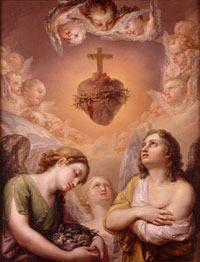 |
|
Angels
Adoring the Heart of Jesus, by Vicente Lopez
Portana | On Good Friday , Jesus Christ was executed by
crucifixion. His body was taken down from the cross, and buried in a cave.
The tomb was guarded and an enormous stone was put over the entrance, so
that no-one could steal the body.
On the following Sunday, some women visited the grave and found that
the stone had been moved, and that the tomb was empty. Jesus himself was
seen that day, and for days afterwards by many people. His followers
realised that God had raised Jesus from the dead.
** The Easter Vigil Service (15 April 2006
)
The Easter Vigil service
(photo) is
the first Easter service, and takes place on the night of Holy Saturday.
Holy Saturday is the Saturday after Good Friday which is often, but
wrongly, called Easter Saturday.
The idea behind the service is for faithful Christians to wait and
watch, hopeful and confident that Christ will return at midnight.
The Easter candle (photos) is
lit during this service. The service traditionally begins outside the
church, where minister and some worshippers gather around a fire - a
charcoal brazier is common.
The service begins with words like these:
Brothers and sisters in Christ, on this most holy
night, in which our Lord Jesus Christ passed over from death to life, the
Church invites her members, dispersed throughout the world, to gather in
vigil and prayer.
After being lit outside, the candle is carried into the church, where
most of the worshippers are waiting in darkness, which symbolises the
darkness of Christ's tomb.
(英語點津陳蓓編輯) |
|
|
| Vocabulary:
|
| |
|
vernal equinox: 春分
Eostre:
伊奧斯特,撒克遜黎明女神。它的原意是指“冬日逝去后春天的太陽從東方升起,把新生命帶回”。由于該詞喻意“新生”,于是被基督教教徒借用過來表示光明的恩賜者耶穌再次回到人間。
Phoenician:
腓尼基人的,生活于敘利亞沿岸
Astarte:
阿斯塔蒂,腓尼基人所崇拜的豐饒女神,傳統(tǒng)上掌管愛情和生育。
The Easter Vigil
Service:
復(fù)活節(jié)守夜禮,在復(fù)活前夕,教會守夜不眠、等待著基督的復(fù)活,并以圣事來慶祝。守夜禮分四個主要部分:燭光禮,圣道禮,洗禮,圣祭禮。
Good
Friday: the Friday before Easter, observed by Christians in
commemoration of the crucifixion of
Jesus(耶穌受難日,復(fù)活節(jié)前的星期五,被基督教徒作為耶穌受難節(jié)予以紀(jì)念) |
|


