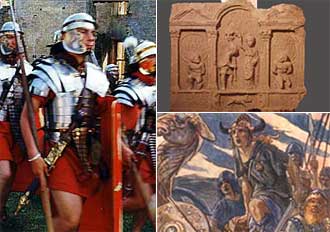
 Scotland in Prehistory
Scotland is known to have been inhabited for about 6-8000 years, with successive waves of settlers and invaders. Celts from North-West Europe arrived about 500BC. They were called Britons by the later invading Romans. Although these temporary conquerors referred to the northern lands above the line of the Forth and Clyde as Caledonia, they alternatively named the northern tribes Picts and all of these terms are used today in describing the early history of Scotland. The name Scotland derives from the Scoti, another Celtic tribe, who came from Ireland and in the 5th and 6th centuries had settled on the western seaboard in present-day Argyll in sufficient numbers to form the Kingdom of Dalriada where they spoke Gaelic.
The Vikings in Scotland
The Vikings' boat-building and navigational skills and their fearsome reputation as they pillaged and plundered more prosperous lands meant that by the 10th century, they had ravaged Europe and Asia Minor, established a base in Iceland, colonised Greenland and probably landed in North America centuries before Columbus.
In Scotland, the invasions and settlement of Vikings from Scandinavia were one of the country's most formative influences.
When they first arrived in Scotland at the end of the 8th century, the Vikings were only interested in conquest and plunder. In 794, they first attacked Iona, the heart of the Celtic Church, and returned on successive years to loot and pillage. Driven by the over-population of settlements on Norway's west coast, colonisation of the ravaged territories soon followed and before long Norse society and culture had become firmly established in Shetland (Hjaltland), Orkney (Orkneyjar), the Western Isles (Su'ereyar) and Man (M'n). They used these as bases to attack the mainland and to colonise its remoter parts such as Caithness and Galloway.
However, the Viking invaders did not always destroy what they found: archaeological evidence suggests that at Brough on Birsay, the long-houses of the incomers respected the sacred site of a Pictish monastery. Indeed, many of the settlers were later converted to Christianity. The largest Norse settlement so far discovered is at Jarlshof in Shetland and another has been excavated at Udal in North Uist.
Throughout the settled lands, the Vikings established territories known as jarldoms (from which we get 'earldoms'). Though semi-autonomous, each was under the ultimate sovereignty of the kings of Norway. This continued unchanged until the 13th century when, following the Viking defeat at the Battle of Largs in 1263, Norway surrendered control of the islands, Kintyre and Man to Scottish control. Norse control lasted longest in Shetland, which was ruled, directly from Bergen until the 15th century.
Today, the most enduring evidence of the Viking settlement of Scotland can be found in the many Norse place names that can be found throughout the northern isles, the Hebrides and along the western seaboard.
The Romans in Scotland
Unlike England, Scotland was never considered part of the Roman Empire although the Romans did advance into Scotland several times during their 300-odd years in Britain.
Their first foray north was made in 79 or 80 AD by Cnaeus Julius Agricola from Carlisle, reaching as far as Perthshire. Later expeditions in 82 and 83 established forts as far north as Aberdeenshire and the following year Agricola's forces defeated the native Caledonii at Mons Graupius. However, most of his forts were abandoned shortly after and by 118, the effective limit of Roman rule was marked by Hadrian's Wall (named after the emperor Hadrian), a defensive barrier running across the north of England between the Tyne and the Solway.
During the 140s, the Romans tried to move their border northwards and built a new defensive barrier, the Antonine Wall, between the Forth and the Clyde. For the next forty or fifty years, the Romans regularly occupied and abandoned this position in favour of the security of Hadrian's Wall.
Between 208 and 211, the Emperor Septimus Severus conducted a major campaign against the Caledonii and other tribes from major camps based around the Tay and Angus. When Severus died in 211, the Romans retreated again to Hadrian's Wall.
The final incursions came a century after Severus but this time, the Picts (a confederation of tribes based north of the Forth) fought back and by 367 had overrun Hadrian's Wall which the Legions finally abandoned in 400.
點(diǎn)擊查看本頻道更多精彩內(nèi)容




