 |
 |

當(dāng)前位置: Language Tips> VOA聽力> Special Speed News VOA慢速
Now, the VOA Special English program WORDS AND THEIR STORIES.
Expressions about water are almost as common as water itself. But many of the expressions using water have unpleasant meanings.
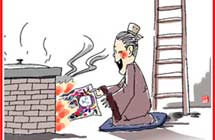
The expression "to be in hot water" is one of them. It is a very old expression. "Hot water" was used five-hundred years ago to mean being in trouble. One story says it got that meaning from the custom of throwing extremely hot water down on enemies attacking a castle.
That no longer happens. But we still get in "hot water." When we are in "hot water," we are in trouble. It can be any kind of trouble -- serious or not so serious. A person who breaks a law can be in hot water with the police. A young boy can be in hot water with his mother, if he walks in the house with dirty shoes.
Being in "deep water" is almost the same as being in hot water. When you are in deep water, you are in a difficult position. Imagine a person who cannot swim being thrown in water over his head.
You are in deep water when you are facing a problem that you do not have the ability to solve. You can be in deep water, for example, if you invest in stocks without knowing anything about the stock market.
"To keep your head above water" is a colorful expression that means staying out of debt. A company seeks to keep its head above water during economic hard times. A man who loses his job tries to keep his head above water until he finds a new job.
"Water over the dam" is another expression about a past event. It is something that is finished. It cannot be changed. The expression comes from the idea that water that has flowed over a dam cannot be brought back again.
When a friend is troubled by a mistake she has made, you might tell her to forget about it. You say it is water over the dam.
Another common expression, "to hold water," is about the strength or weakness of an idea or opinion that you may be arguing about. It probably comes from a way of testing the condition of a container. If it can hold water, it is strong and has no holes in it.
If your argument can hold water, it is strong and does not have any holes. If it does not hold water, then it is weak and not worth debating.
"Throwing cold water" also is an expression that deals with ideas or proposals. It means to not like an idea. For example, you want to buy a new car because the old one has some problems. But your wife "throws cold water" on the idea because she says a new car costs too much.
(MUSIC)
This VOA Special English program, WORDS AND THEIR STORIES, was written by Marilyn Christiano. I'm Rich Kleinfeldt.
相關(guān)閱讀
Obama hopes charm offensive will lead to grand bargain
Struggling to understand the Iraq war, 10 years later
Texting while walking can be dangerous
Words and their stories: It will not wash
(來(lái)源:VOA 編輯:Julie)

添加Chinadaily_Mobile
你想看的我們這兒都有!

中國(guó)首份雙語(yǔ)手機(jī)報(bào)
學(xué)英語(yǔ)看資訊一個(gè)都不能少!
關(guān)注和訂閱

口語(yǔ)
關(guān)于我們 | 聯(lián)系方式 | 招聘信息

電話:8610-84883645
傳真:8610-84883500
Email: languagetips@chinadaily.com.cn