Journey into Chinese culture along subway lines
Line 5 of the Beijing Subway, opened on 7th October 2007, is Beijing's first north-south subway line. It runs for 27.6 km, in a near straight line, just east of the city centre from Tiantongyuan North in Changping District to Songjiazhuang in Fengtai District, connecting five main districts of Beijing: Fengtai, Chongwen, Dongcheng, Chaoyang and Changping.
Line 10 of the Beijing Subway (I), opened on 19th July 2007, is a major subway line which joins the east and north of Beijing together. It lasts 25 km long.
Both are important subway lines in Beijing. Many of the places the lines pass by have a long and interesting history. On line 5 and 10, citizens not only enjoy the convenience of modern transportation, but it’s also likely that they will have a journey of Chinese Culture.
Subway stations of Line 5
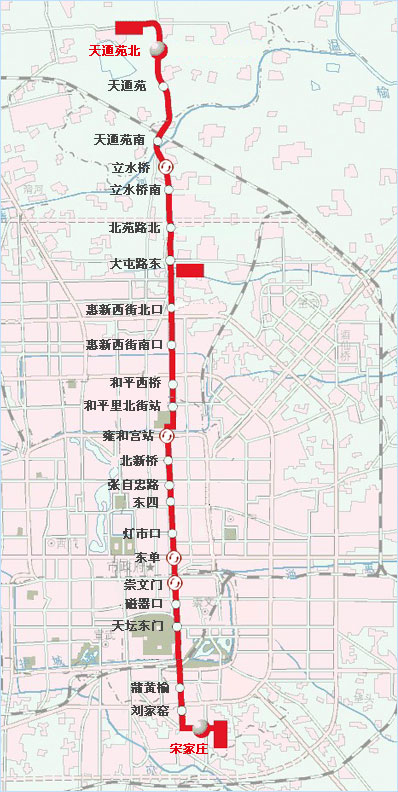 |
|
Line 5 |
Beixinqiao Subway Station
It’s located on the high street of Beijing. The name of place has a long and interesting story. Once upon a time, there was a hero whose name is Yao Guangxiao. He had fought against the Emperor Chinese Dragon for a long time. Eventually, Yao was so superior to the dragon that it hid himself in a well to avoid being punished. Yao locked the well with an iron chain, constructed a bridge over it and claimed that the dragon could never come out of the well before the bridge gets old. Every bridge gets old. However, the dragon hadn’t been happy for long because Yao named the bridge “Xin”, which means new in Chinese. No one has seen this Emperor Chinese dragon ever since.
Tiantongyuan South Subway Station
The Tiantongyuan South Subway Station was constructed to resemble the Olympic Rings Car. Red as its theme, the subway station put each of the five rings color on a big board and has them connected by a huge information wall. It represents the close friendship of the five parts of the world. People in the station have access to the sunlight from every angle because of the translucent glass. As a matter of fact, it’s very easy for one in the station to notice what’s going on outside, while on the other hand , people out of the station can hardly see through the glass, which adds mystery to this subway station.
Lishuiqiao South Subway Station
China is famous for its Chinese Dragon. The exterior outline of the station is just designed after this world renowned Chinese figure. In Chinese culture, the Chinese Dragon is a composition of physical strength and spiritual perseverance, which always reminds people of mundane achievements. Actually, the appearance of the station is like an invisible Chinese Dragon, with white columnar reinforcing steel bar interleaving as its bones and the irregular glass windows as its squama. What’s more, the extraventricular stairs at the four exits are like natural claws and it’s amazing to see people walking in and out from them.
Huixinxijie Beikou Subway Station
The layout of the station is plain but exquisite. The artistic ceramic wall inside is decorated by a series of Chinese calligraphy works that are originated from very famous Chinese ancient books like Three-character Scripture, Thousand-Character Essay, Hundred Family Surnames, etc.
Lama Temple Subway Station
 |
|
|
 |
|
|
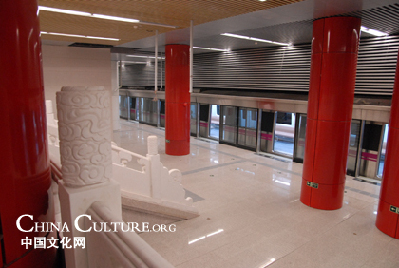
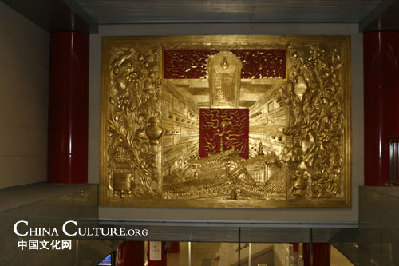
This station is the joint intersection of Subway Line 2 and Subway Line 5. Not far from it is the distinguished Lama Temple, which used to be the accommodation of Yinzhen, the fourth son of the renowned emperor of Qing Dynasty Kangxi. After Yinzhen took office, he made the place state department. His son Qianlong changed it to Lama Temple to help him achieve his religious end after his death, also with the purpose of comforting the monks in Tibet and Mongolia area.