To taste oriental culture – starting from bowls and chopsticks
Westerners are very particular about courtesy when dining, eating dishes in a fixed order. Even the manner of placing tableware is restricted.
Chinese are much easier at the table, and all they use are a bowl, chopsticks and a spoon. Just like the western saying where “less is more,” in Chinese traditional table ware is both simple and ingenious.
To treat the matter of eating as a part of ‘life art’, we can start from table ware.
A bowl, emerging from thousands of years of civilization
China is an ancient agricultural country, so that as early as the Neolithic Age, people had already understood to dine with bowls.
 |
|
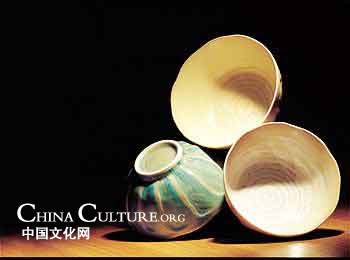
Bowls with emerald green grain, simple but elegant |
The bowl, wide at the top and narrow at the bottom, was hard to stand steadily on the flat, so that archaeologists believed that the ancients initially put bowls in holes dug on the ground. The earliest bowls were earthen, needing only 600 to 700 degree for firing. According to archeological findings and historical records, the first porcelain bowl appeared during the period of the Shang (about 1600 – 1100 BC) and Zhou (1122 BC – 256 BC) to Spring and Autumn (770 – 476 BC) and Warring States (475 – 221 BC) periods, which was an original work of celadon porcelain.
Till the Han Dynasty (206 BC – 220 AD), the using of the bowl took on multiple purposes, divided from usage for holding rice, soup, dish, tea and wine, and its new main function was to serve as a sacrificial appliance. From primitive society to the Qin Dynasty (221 – 207 BC), commonly people used pottery ding (an ancient cooking vessel) or bronze ding for sacrificial ceremony, but from the Han Dynasty, big opening bowls came in to use for containing immolations. Up till now, the biggest blue-and-white porcelain has been found for sacrificial use.
 |
|
An elegant woman painted on the bowl is based on the appearance and trapping of women in the Tang Dynasty. |
All the bowls remaining are porcelain in Dehua, which is also known as “the capital of porcelain”. The earliest bowl in the Dehua Ceramics Museum was one from the Tang Dynasty (618 – 907 AD), when white porcelain was most common. Later blue-and-white porcelain bowl emerged, and the technique reached its peak in the Qing Dynasty (1644 – 1911 AD).
In the Ming Dynasty (1368 – 1644 AD), most bowls adopted the decoration with floral pattern, which oriented from Changsha kilin in the Tang Dynasty and began to blossom in the Ming Dynasty. The most common used bowls were catering bowls with white ground and blue designs during this period. Qing porcelain bowls exceeded previous ones from every aspect, skillful craftwork, rich and varied in shape, glaze and designs. It takes one’s breath away to see tri-color porcelain, five-color porcelain and powder doped color decorated porcelain bowls for the exclusive use of the emperor.
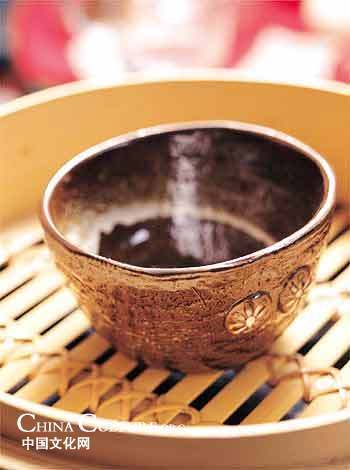 |
|
A traditional Chinese porcelain bowl of fine feel, simply shaped with the color of figuline |
Bowls have been made from a variety of materials: porcelain, wood, jade, glass and metal and delicately made antique bowls are a collectors’ favorite. Compared with golden, silver and wooden bowls, porcelain bowls are more common and widely used and for everyday Chinese most cannot dine without it. Thus many Chinese usually say “golden bowl” or “iron bowl” to describe their living condition.
Wine also has been wedded to bowls from ancient times, and now the custom remains in Inner Mongolia, Tibet and other regions.