Traditional folk toys
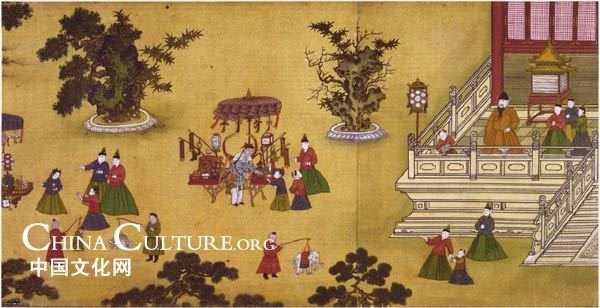
Zhu Jianshen (1447-1487), a Ming Dynasty sovereign of the Forbidden City from 1465 to 1487, was more of a romantic artist than an emperor, and he was fascinated by the lives of those beyond the imperial walls. During the Lantern Festival of 1485, he ordered a duplication of folk celebrations in the palace.
In no time, a spacious courtyard was converted into a lantern fair; archways made of branches were erected and hung with row upon row of lanterns, booths were set up with "vendors" hawking their wares, and folk artists and performers demonstrated their skills. The entire imperial family, eunuchs and court maids attended the lantern fair without ceremony, and even the emperor himself was dressed like a commoner, as children and youngsters scampered about holding lanterns. It was the happiest festival that Zhu Jianshen had ever spent, and he ordered court artists to record the scene on a scroll.
 |
|
|
Later, the painting was known as Ming Emperor Xianzong Enjoying the Lantern Festival. The emperor appears in three places in the painting wearing a bright smile. The painting was shown at the 2008 Beijing Olympics opening ceremony.
Floral Lanterns
 |
|
|
The Chinese call various kinds of lanterns that are meant for entertainment and admiration "huadeng," or "floral lantern," and they are used on special occasions, the most important being the Yuanxiao Festival on the fifteenth day of the first lunar month. As indispensable as yuanxiao (boiled sticky rice flour balls with sweet fillings) are for the dinner table, various kinds of lanterns, either hung as decorations or held in people’s hands as toys, are essential for the festival. Therefore, people also call it the Lantern Festival.
Hanging lanterns during the Yuanxiao Festival began 1,000 years ago as a folk custom. During the Tang Dynasty (618-907), the imperial court decreed that lanterns should be hung across the country for three days during the festival, and the number of the days were increased to six in the Song Dynasty (960-1279). By the Ming Dynasty (1368-1644), it was not until the 10th day that lanterns were taken down. As the festival duration extended, more activities were added. In addition to lantern shows, folk performances and fireworks were included.
Lantern-making techniques improved with the popularity of the festival. Various kinds of materials were used, and new styles developed. The "lantern hill" appeared during the Song Dynasty. It was a scaffold hung with lanterns, and viewed from a distance it looked like an illuminated hill.
Figure lanterns are probably the largest kind of floral lantern. They are made of bamboo strips or metal wires shaped into human or animal figures, then covered with colorful tissue paper. A candle burns at the bottom of the lantern. Children like to show off their lanterns and compare them with those of other children.
Skeletonless red lanterns are made entirely of paper, and are inexpensive to make. They are mostly hung as decorations. Palace lanterns are the luxury category of floral lanterns, using precious wood and other exotic materials. They exhibit exquisite workmanship, such as carving and painting. Conventionally, they are octagonal, hexagonal and tetragonal in shape, and there are hanging, tabletop and hand lanterns.
There are also merry-go-round lanterns — lanterns in human and animal shapes hung from a wheel that revolves around a shaft. These were seen as early as the Song Dynasty.
Kites, the Earliest Aircraft
 |
|
|
 |
|
|
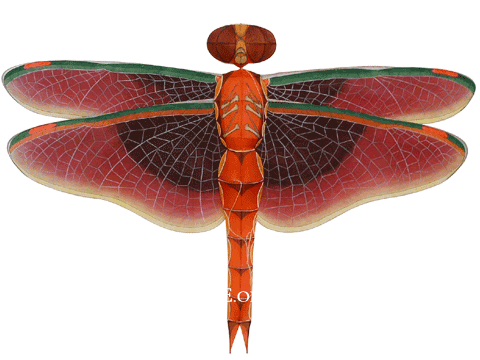
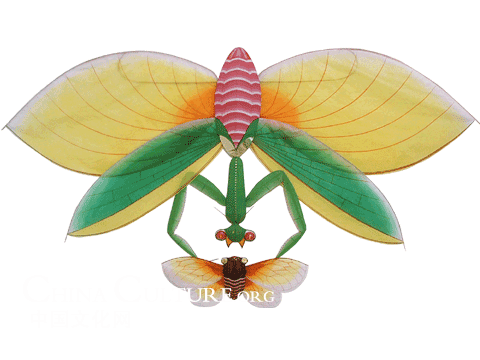
Historical records show that kites had at least seven names in ancient China, all borrowed from the names of birds, which probably inspired kite makers. During the late Tang Dynasty 1,000 years ago, some craftsman installed music strings on his kites, and in the air they produced a sound like that of a zither, so people called them "fengzheng," or literally "wind zither," a name still used today.