Museums in the stamps
A museum is an institution for the collection of cultural relics and specimens, education and research, and as such is an important component of China’s scientific and cultural undertakings. After the founding of the People’s Republic of China (PRC), a series of museums were built, most of which have been featured as a theme on stamp’s designs.
The Stamp of National Central Museum of Natural History
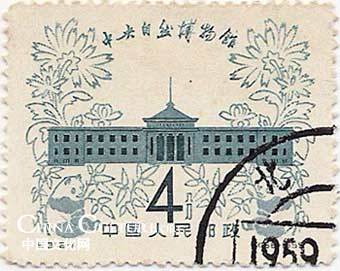
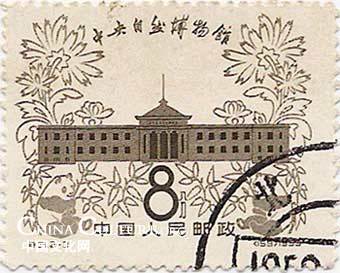
Covering an area of 12000 square meters, the National Central Museum of Natural History was built in 1950 with 18000 square meters of building area and 6000 square meters of exhibition area. Since it was constructed under the aid of the former Union of Soviet Socialist Republics, its building was featured by Soviet style. It was renamed as Beijing Museum of Natural History in February 1962. With four basic exhibition rooms and more than 100000 cultural relics, fossils and specimens in collection, the museum is famous for the number of mammal fossils. The Ministry of Post and Telecommunication issued two kinds of stamps on April 1 1959, respectively with the postages of 4 cents (RMB fen) and 8 cents.
|
  |
|
|
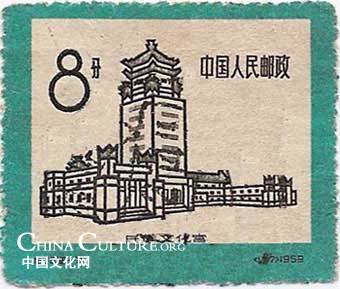
The Stamp of Cultural Palace of Nationalities
  |
|
|
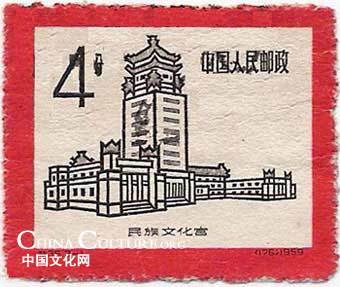
Situated at west Chang’an Road and serving as a museum, the Cultural Palace of Nationalities is an exhibition center featuring a national flavor, designed by the local Beijing Institute of Architectural Design and opened in September, 1959. It had the reputation as one of the top 10 architectural creations in Beijing to celebrate the 10th anniversary of the founding of PRC, the cultural palace of nationalities was not only chosen as the top of the fifty buildings of “My Best Favorite Architectures of National Style” in Beijing in 1994 but also listed as one of masterpieces of Modern Chinese Architectural Art by the International Union of Architects in 1999. The Ministry of Post and Telecommunication issued two kinds of stamps with the theme of Cultural Palace of Nationalities on December 10, 1959.
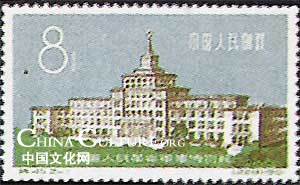
The Stamp of Military Museum of the Chinese People’s Revolution
The Military Museum of the Chinese People’s Revolution stands on the north side of the central section of Fuxing Road directly south of the Yuyuantan Park. The museum is composed of two four-story wings and a main building of seven stories topped with the gilded emblem of the Chinese People’s Liberation Army.
 |
|
|
The museum occupies a total area of 60,000 square meters. After passing through the lobby, one comes to the central exhibition hall, which contains over 500-odd photographs and more than 1,000 mementos of the Chinese revolution led by Mao Zedong over the course of half a century. On the eastern side of the main building, the three floors are taken up by specialized halls.
The first floor is devoted to the Second Revolutionary Civil War (1927-1937), the second floor to the War of Resistance Against Japan (1937-1945) and the third floor to the Third Revolutionary Civil War (1945-1949). The exhibits in these three halls depict the 28 years from the founding of the Chinese Communist Party in 1921 to the establishment of the People's Republic of China in 1949. Sections devoted to the People's Liberation Army and the masses show the importance of their participation in the revolutionary wars.
There is also a special section devoted to noted revolutionary martyrs such as Norman Bethune and D. S. Kotnis. In the western wing, the first floor exhibition hall contains a general exhibition while the second and third floors house a display entitled “The Protection of Socialist Revolution and Construction.” The outdoor plazas on either side of the central hall exhibit representative weapons used by the People’ s Liberation Army and the weapons captured from the enemy during various periods of the revolutionary war.