Father of Pinyin
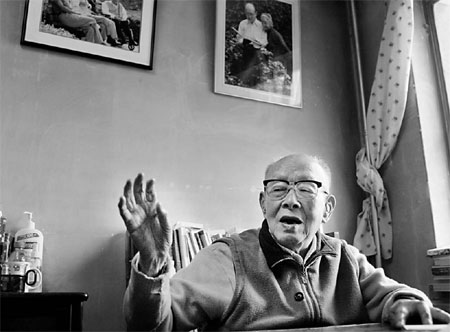
Throughout the long interview Zhou displayed an unflagging modesty. Perhaps it is because he is currently writing about Confucius, for whom humility was such a key trait. "Yes, I visited Einstein a couple of times," he says matter-of-factly. "But I didn't understand relativity at all so we just chatted about everyday things." Did he ever meet Chinese leaders? "Of course - Mao Zedong, Zhou Enlai, Deng Xiaoping, I met them all - but for a long time I was a member of the Chinese People's Political Consultative Conference (CPPCC) so I was bound to."
"A national conference had been convened," he recalls. "One month later it listed three tasks that needed immediate attention: to popularize Mandarin as the national language, to simplify the Chinese characters and to devise a new alphabet to represent those characters.
"Even then we knew how important this task was - at that time 80 percent of the country was illiterate and how to raise the cultural understanding of the masses was a very big problem.
"I was one of the few people in China with any knowledge of linguistics and was therefore
|
|
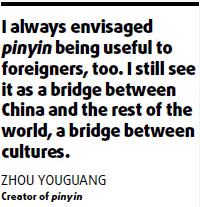
The job was not without its sacrifice. "At that time I was an economics professor in Shanghai and my three jobs paid me more than 600 yuan a month. This new job paid me a monthly salary of just 250 yuan, which was still good money at the time."
Two research bureaus were established by the conference - one to develop the new alphabet and one to simplify the characters. Zhou headed the former. "I worked full-time on it for three years," he says. "Throughout that time I had less than 20 people to help me.
"You might ask why it took so long to complete an apparently simple task but it created a multitude of problems. We received more than 4,000 letters from people in China and overseas. They were full of questions, requests and suggestions. I had to reply to every one in academic language."
So how does he evaluate his creation, half a century on? "It is not an absolute solution but it is what it was meant to be," he says. "It has worked better than the previous phonetic alphabet used here (for instance, Zhuyin) or the previous attempt at romanizing Mandarin (Wade-Giles), which had been in use for 100 years when we developed pinyin.
"As soon as we completed it, it was approved by the National People's Congress and adopted as a method for teaching Mandarin to every primary school child in China - at 50 million a year, that is a billion Chinese who have used it to learn how to read and write. It is not perfect but it has worked."
Zhou is especially thankful his peers allowed him to base
|
 |
Events have certainly vindicated him. The International Organization for Standardization acknowledged pinyin in 1982 as the standard system for Chinese phonetic instruction and it has also had the seal of approval from various other bodies, including the United Nations.
Nor has it escaped this centenarian's attention that pinyin has gained a new following in the IT age. "Did you know Chinese people use it to send messages on their cell phones and to type into keyboards - that makes me very happy!" he says with a broad grin.
It is not unreasonable to see pinyin's usefulness here and overseas as a death knell for Chinese characters but Zhou rejects the notion. "If you want to use pinyin to write Chinese, that's OK but it only exists as an aid for Chinese characters, not to replace them. If that were not official policy people would oppose its use altogether. Could the characters ever be cast aside? Not for a thousand years - or more."
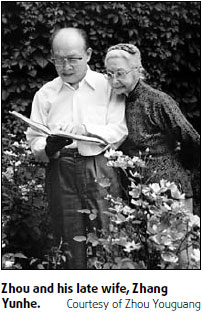
On the wall hang all too few photographs of Zhou's life. One with pride of place is that of his late wife, Zhang Yunhe, who died in 2002 at the age of 93. "We were married in 1933 and stayed happily together for, wait, 69 years," he says, quickly doing the math. The couple had a daughter, who died at the age of six, and a son, who still lives in Beijing. "He's my old baby - he is 76," says Zhou. There is also a granddaughter in the United States and a great-grandson, who will soon go to university.
Too many of his memories are now in his mind alone. "During the 'cultural revolution' (1966-76) I was sent to the countryside to be re-educated by the farmers," he says, without a hint of resentment. "During that time my house was occupied and all my photographs - with Mao, with my pinyin research colleagues - were destroyed."
Without any need, this humble man repeatedly apologizes. "Please bear with me - my health is still good but my hearing is not what it was," he says.
In truth, he is still more productive than many people a quarter of his age and to date has had more than 30 books published. "I retired from full-time work when I was 85 but I'm still writing," he says.