Taiwan Woos Pili Puppet Show
 |
|
|
Review of history
Pili puppet show can be traced back to the late Ming Dynasty and the early Qing Dynasty around the 17th century in Quzhou or Zhangzhou in China’s southern Fujian Province. Traditionally, the puppet’s head is made of wood carved into the shape of a hollow human head. Aside from the head, palms and feet, which are made of wood, the puppet’s torso and limbs consist entirely of cloth.
Waves of Chinese immigrants began to cross the Taiwan Strait from southern Fujian and Guangdong provinces to Taiwan in the early 1600s, bringing the folk-art form with them. Taiwan remained a rugged frontier society until the late 1800s, and in most areas the puppet show was the most popular form of entertainment. As a result of the initial immigration, it took on a brand-new style.
 |
|
|
The current TV Pili puppet show series started in 1985, and still continues today.
A new stage
The series production is a family business run by the Huang family, perhaps Taiwan’s most renowned and accomplished family in this field. Huang Haidai once invented a form of puppet show. His son Huang Junxiong released the first Pili series named Pili City, creating the legendary characters mentioned above and causing a sensation through TV.
Later, the Information Bureau in Taiwan limited the time of fighting action to be allowed on TV and movies. Affected by this prescription, Pili puppet show went steadily downhill, while the third generation of the Huang family decided to change. The two brothers Huang Qianghua, in charge of playwriting, and Huang Wenze, in charge of most of the characters’ voicing, exploited Pili puppet show further, changing the art greatly.
 |
|
|
First, they used special effects such as animation and pyrotechnics and utilized more elaborate sets creating very realistic and intriguing backgrounds.
 |
|
|
Second, story lines became more complicated. Rather than relying on traditional stories, producers began to write new scripts that would attract younger audiences. Besides, the producers started enriching the characters’ personalities. No man is perfect, even the leading character Su Huan Zhen has his own shortcomings. This makes the characters close to life and intimate with the audience.
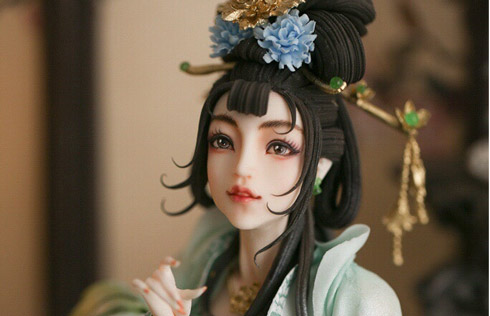
Third, puppets’ faces started to reflect their personalities. In the traditional show, the color of a puppet’s face indicated their fundamental personality. A red face represented honesty and loyalty. Black represented an uncouth, unsophisticated individual. Green meant a sinister, scheming soul. As in traditional society, garments indicated social status. Mandarins and gentry had lovely embroidery, with symbols such as flowers, birds, and animals differentiating position. But now, the audience finds it more and more difficult to tell good from bad only by exterior appearance. A good-looking man turns out to be an evil, while an ugly man a good person.
 |
|
|
Thanks to innovations such as these, it seems that Pili puppet show will continue to be around well into the next century.
By Xie Fang