Historical hair ornaments and their Social connotations
Hairpins and hair clasps were everyday embellishments in old China. During the Ming (1368-1644) and Qing Dynasties (1644-1911), women's hair ornaments expressed traditional Chinese thought and culture in exquisite, sophisticated techniques.
|
|

The generic term for hairpins and hair clasps is ji. A one bar ji keeps coiled hair in place, and a two bar ji is a feature of the hairstyle itself. Before the Qing Dynasty (1644-1911) both Chinese men and women wore their hair in a coiled bun with a ji to keep it in place.
The fashionable designs and diverse patterns of these ornaments made them a favorite ornament with women of all social strata.
|
|

Fashioned in materials that included jade, gold, silver, ivory, bronze and carved wood, the style, materials and craftsmanship of these hair ornaments reflected both social status and Chinese ethnic culture.
The patterns, craftsmanship, materials and number of hair ornaments a woman wore signified her social rank. Feudal etiquette defined the style of hair ornaments women wore on formal occasions, such as weddings or court ceremonies.
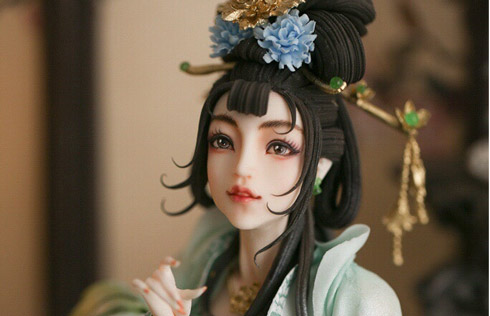
The elaborate buyao hairpin was an exquisite hair ornament denoting noble status. Often encrusted with jewels and featuring carved designs, the main feature of a buyao was its pendants that flatteringly framed the wearer's face and "danced" as she moved, hence the name buyao, which literally means "shake as you go". This ornament was generally made of of gold in the shape of a dragon or phoenix and adorned with pearls and jade.
|
|

Hair ornaments worn by women of wealth also took the form of gold flowers encrusted with jewels depicting flowers or animals.
Among popular decorative patterns were auspicious birds and beasts, such as the dragon, phoenix, crane, deer and the 12 animals of the Chinese "zodiac." The deer was considered a propitious animal because its pronunciation in Chinese is the same as that for six, which denotes success. Hairpins in the design of a mandarin duck denoted married bliss. Patterns of flowers and fruit-bearing trees featured the peony, lotus flower, plum, guava and asphodel. The five petals on a plum represent blessings, high-salary, longevity, luck and wealth.
|
|

Designs depicting auspicious objects included musical instruments, chess pieces, calligraphic characters, and the "four treasures of the scholar's studio" comprising the calligraphy brush, ink stick, ink slab and paper.
But to the women of ancient China the ji was far more than just a hair ornament. The ji ceremony, which bestowed a hairpin upon a young woman when she reached the age of 15, was a rite of passage signifying that she had reached marriageable age.
A hairpin also functioned as a love token. When Chinese lovers of ancient times were forced to part they would often split a hairpin, both keeping a half with them at all times until they were reunited.