Faint praise for Great Plains
By Liu Jun (China Daily)
Updated: 2010-01-29 09:05
 |
Large Medium Small |
Farmers in Shaanxi who offer goats and pigs to the Mountain God at Spring Festival, writers in the northwestern province offer themselves to the Muse of Literature, says Gao Jianqun, a writer based in Xi'an, the provincial capital.
"Most of us fail, but we still carry on, hoping that a miracle will happen," says Gao, with his heavy dialect, in a telephone interview.

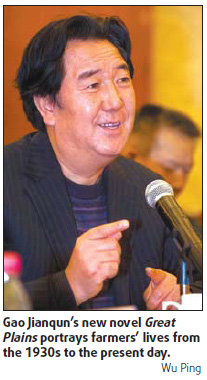
It seems Gao has half-succeeded with his new novel, Great Plains (Da Pingyuan), published by the Beijing October Arts & Literature Publishing House last October.
Calling it a "half-autobiographical" novel, the 57-year-old says it's the best tale he's ever told.
The work has amazing details that display a deep reverence and love for rural life, tracing the lives of three generations in a farmer's family. But literary critics have frowned at the ending, where Gao attempts to chronicle urbanization.
Compared with other writers in big cities, writers in Xi'an "live in the past" and "write about heavy themes" as they enjoy a slow-paced life in a less developed economy, Gao says.
What makes him different from other well-known Xi'an writers like Jia Pingwa and Chen Zhongshi, are his experiences as a soldier patrolling the Sino-Russian border in the early 1970s; and his extensive research on the exchanges and clashes of Eastern and Western cultures in Northwest China. While White Cottage (1987) was an excellent summary of his youth, The Last Xiongnu (1993) looks at East-West culture clashes.
In the new novel, which took him some four years to complete, Gao gives a vivid portrayal of farmers' lives from the 1930s to the present day. Besides colorful language and strong emotions, he impresses the reader with bold characters.
Gao Fasheng, grandfather of the narrator Gao Jian (clearly based on the writer himself), is a larger-than-life figure who often quotes from Qinqiang Opera. But when something important happens, he often misjudges the situation.
His wife, Gao'an Shi (surnamed Gao and An), in contrast, has an extraordinary presence of mind in a crisis. When robbers break in at midnight, she calmly takes out their valuables and asks the bandits not to hurt them - while her husband is shaking under the quilt.
Gao Jian's parents are another interesting pair. The father is an official and tries in vain to shake off his rural relations; the mother, Gu Lanzi, fulfils her duty as wife and mother. Her story gives the novel another important dimension.
On June 6, 1938, Kuomintang troops blew open the Yellow River dyke at Huayuankou, Henan province, to stop the Japanese army. While more than 7,000 Japanese soldiers drowned, 890,000 Chinese civilians also died, nearly 4 million became refugees.
Barely 10 years old, Gu is the only survivor of her family and she enters the Gao family as a daughter-in-law. Many critics have pointed out that the novel is like an epic about heroic women in the countryside.
There are other striking details from the author's own experience. In the early 1960s, when the entire country was caught in a famine, many died eating a special clay known as guanyintu, earth of the Goddess of Mercy.
Contrary to common belief, the clay is white only on its dry surface. Its core is shiny black, almost like coal. It tastes crispy and greasy, much better than willow leaves, corncobs and the extracted skin of cottonseeds that the starving people ate.
If the stories of Gao Jian's forefathers are touching, Gao Jian's experience as a soldier on the border seems to drift away from the well-established rural theme.
With Gao Jian's return, the author tries to discuss the changes brought by modern life, to rural life. He presents news-like tales about entrepreneurs who invest huge amounts of money to turn the village into part of Xi'an.
"The novel could be an international competitor if it ended at the death of Gao Jian's father," remarked literary critic Lei Shuyan. "The part about urbanization is redundant."
But the author believes that the urbanization part has lifted the novel from a mere chronicle of a rural family to an attempt at interpreting the past 30 years of opening and reform.
"It shows the direction of China's reform - urbanizing vast rural areas that will sustain the country's development for another 30 years to come," Gao says, admitting the novel would have been better if the entrepreneurs' tales were told through Gao Jian's viewpoint.
This year, Gao hopes to finish another major novel based on Kumarajiva, who introduced Buddhist classics to China in the 4th century. Though he has read tons of history books, Gao plans to follow in the footsteps of the ancient sage, along the Silk Road.
"It will be a dialogue with the world," Gao says.
Perhaps, this time, Gao will win the Muse's favor completely.