Touch of class
By Mei Jia (China Daily)
Updated: 2010-02-26 09:50
 |
Large Medium Small |
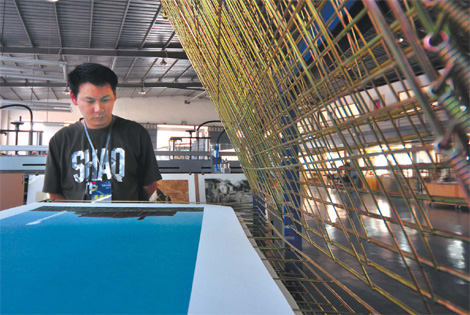
New novel on migrant workers tells a story from the heart, from one who's lived that life. Mei Jia reports
Migrant workers are an oft-neglected aspect of the Chinese economic success story. While there have been other books on them, a new novel offers an impressive account of what it means to be one, by someone who has lived that life.
Wang Shixiao, 38, grew up in a village of southern Hubei province. The junior high graduate worked his way up as a factory worker to become a self-taught literary star.
The Guangzhou-based writer has written five novels and three collections since 1999 under the penname, Wang Shiyue. Literary critic Chen Fumin calls him the "most original migrant worker writer" - one who has witnessed the making of history.
Wang says the first 15 years of his wage-earning days were mind-boggling hours of hard labor. Only over the past five years, has he been able to contemplate what it means to be a migrant worker.
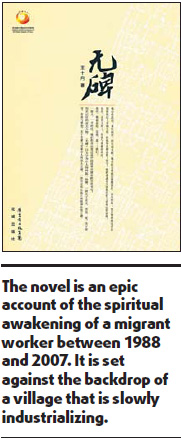
He has put this introspection into Li Baoyun, the protagonist nicknamed Laowu, in his latest novel No Monument ().
The novel is an epic account of the spiritual awakening of a migrant worker between 1988 and 2007. It is set against the backdrop of a village that is slowly industrializing.
Wang says he has distilled 20 years of his own experiences into presenting the tough choices facing individuals in a society in rapid transition.
His familiarity with the manufacturing business in China's southern cities, adds enormous credibility to the novel.
Before he started writing, Wang wrote the words "justice, kindheartedness, resolution, faith, youth, dream, suffering, tolerance, and love" on a piece of paper. His protagonist Laowu embodies all of these qualities.
He also carries a palm-shaped birthmark on his face whose purple hue deepens when he gets excited. While a put-off in love, it serves him well whenever the idealist in Laowu has to take an upright stance.
When he leaves for Yaotai village (modeled on Bao'an district, Shenzhen) in Guangdong province in 1992 to realize his "Chinese dream", Laowu meets other characters and together they forge a symphony of the rising "world's factory".
In the beginning, all Laowu wants is to "work hard for some years, get married and start a small business" - a dream shared by all migrant workers of his generation, Wang says.
There are several people Laowu encounters, who leave a lasting impression on him.
There's Li Zhong, the mechanic he meets in a hotel-supplies factory, who introduces to him the idea of workers' rights.
But the strike Li plans puts Laowu in a dilemma: Should he show solidarity with his fellow workmen, or be loyal to the boss who once saved his life. Laowu chooses the latter and spills the beans. The next day Li goes on strike alone and loses his job.
While making his exit, Li tells Laowu: "It's not scary to have a big birthmark on the face. You should not let it grow on your mind."
At another factory, workers organize a strike but chicken out believing Laowu is a traitor. Laowu goes on strike alone on the planned morning just as Li had done. He reclaims his pride.
There's also Liu Ze, a painter-turned-businessman, who encourages Laowu to pursue calligraphy. Liu encourages Laowu in his dream of changing an industrialized Yaotai into a place with clean water and green trees. The two join hands to turn Yaotai into a cultural-industrial zone. Liu also inspires Laowu to believe that the worker and boss are two sides of the same coin.
But this depiction has drawn flak with critics saying Wang has taken too simplistic a view of labor relations.
"I wrote what I've truly felt and experienced," Wang says, in his own defense.
The literary critic Chen says Wang's treatment of social issues is what makes him outstanding. "Wang has a deep understanding of the discourse on Chinese history," he says.
The twists and turns that Laowu's life takes make for touching reading. Migrant woman A Xiang dreams of living like a city girl. She becomes a mistress to a truck driver from Hong Kong (who she thinks is some rich guy) and is abandoned, pregnant. Laowu takes care of her and falls in love. But A Xiang leaves when her son Qiaoqiao completes 100 days.
Eight years later, she returns for Qiaoqiao with her old, wealthy husband as she can't give birth again.
Qiaoqiao is Laowu's whole world and yet, convinced that everyone has the right to pursue happiness, he forgives A Xiang.
"Laowu is what we call a hard-luck hero. His persistence and kindheartedness inject great warmth into the novel," says Chen Qiuping, a Beijing-based film producer who has decided to buy the rights to the novel's film adaptation.
"An ordinary figure's struggles will touch audiences of the big screen," Chen says.
At the end of the novel, Wang has Laowu writing the words "bu chai", ("don't demolish"), on a wall.
"We've lost too much all these years," Wang says. "I want to keep something in Laowu: the ability to love and forgive, and live in harmony with the world."
Wang believes the real "Chinese dream" is for all workers to become true "pillars of society".
Wang is now an editor of a Guangzhou-based literary magazine and is working on Flag Manufacturers, a novel inspired by the "Made in China" American flags that flooded the United States after the 9/11 terrorist attacks.