Wang follows in father's footsteps
By Chen Nan (China Daily)
Updated: 2010-04-10 08:59
 |
Large Medium Small |
|
A pioneering Chinese filmmaker, Wang Xiaoshuai likes to explore the subtle relationships between ordinary people in his films. Du Lianyi / for China Daily |
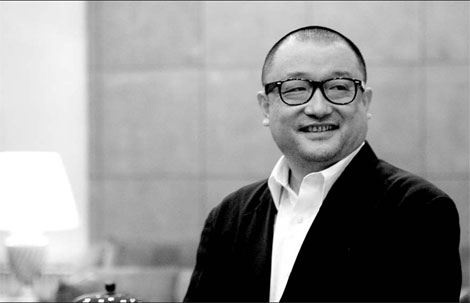
Award-winning sixth-generation filmmaker says while his films may lack an audience, or even a venue, they make him happy. Chen Nan reports
Of all the stories that have been told through movies, the exploration of the subtle relationships between ordinary people is Wang Xiaoshuai's favorite.
As a pioneering sixth-generation Chinese filmmaker, Wang first came under the limelight in the early 1990s with a low-budget psychological drama that follows the struggles of a painter, Liu Xiaodong, in Beijing.
The Days was selected by BBC as the only Chinese-language film in its list of the top 100 best films.
Like many first films, it is a little awkward. But viewed today this debut sums up the themes of Wang's career: It offers a searing look at those who live on the margins of society.
An independent filmmaker, Wang uses his own money and simple digital filmmaking equipment to paint an intimate portrait of Chinese people and their lives.
|
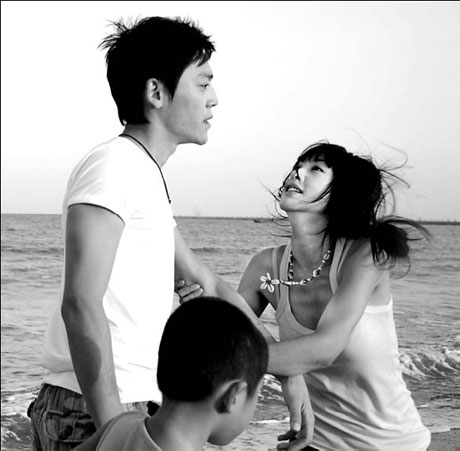
Wang Xiaoshuai's latest movie Rizhao Chongqing delves into the father-son relationship. Provided to China Daily |
"I have worked with no guarantee of an audience or even a screening venue," the 44-year-old director says of his decades of filmmaking. "But I am happy when I make movies. It's a way to express myself and share this with viewers."
Wang's stories are set in different cities of China. For Beijing Bicycle (2001), he trains his lens on the capital; while in his third film, So Close to Paradise (1997), he returns to Wuhan where his parents live. In Shanghai Dreams, (2005), he tells the story of the uprooted lives of a generation that moves from Shanghai in the 1960s to work in undeveloped Guizhou province.
In Beijing Bicycle, Shanghai Dreams and In Love We Trust (2008), Wang touches on the moral dilemmas and struggles of people faced with transition and an older generation's nostalgic memories.
His sharp and humane observations have won the director many international awards, including two Silver Bears at the Berlin International Film Festival and nominations for the Golden Palm at the Cannes Film Festival.
His dedication to art films and his contributions to international cinema also made him a Chevalier in the French Order of Arts and Letters.
Given by France's Ministry of Culture, the honor has also gone to Chinese filmmakers Zhang Yimou and Jia Zhangke.
Wang attributes his filmmaking style to the influence of the French New Wave, while studying at Beijing Film Academy.
At the reception held to celebrate his French honor, the director dedicated it to his father, who died two months ago.
"He supported me when I decided to make films by myself," he says of his father, Wang Jiaju, who was a professor at the Shanghai Theater Academy.
A student of oil painting since childhood, he left his hometown Guiyang at 15 to pursue his film dreams in Beijing, and his father, like most Chinese men, never displayed his affections for him openly.
When Wang senior visited him, he felt depressed seeing his son's poor living conditions. The very first person to see The Days was his father, and he gave him both advice and encouragement.
"When I had the money to make movies, he felt proud of me even though he never expressed it.
"He didn't say much when we were together, but I could feel his concern", Wang recalls.
"Now he is gone. The pain remains."
He delves into the father-son relationship in his new movie, Rizhao Chongqing, which tells the story of a father's search for his lost son.
"There is uncertainty, confusion and love in this story, which is common to every family," Wang says. Starring Wang Xueqi and Fan Bingbing, the movie will hit the screens in June.
Wang's father published a book, Tian Chuang, or Skylight, a record of his decades spent in drama education as well as stories and prose about his generation.
His father's experiences inform Wang's next movie, which revolves around a group of young people supporting the "third line construction" (a campaign during which technicians and skilled workers from big cities were sent to help the construction of the western regions, referred as third line) during the 1970s.
"My father would miss his art career in Shanghai when he and others were transferred from big cities like Shanghai, Harbin and Shenyang to southwest China," Wang says.
"That special era changed and influenced people like my father. I will dedicate the movie to him."