Festival of Westward Movement of the Xibe ethnic group
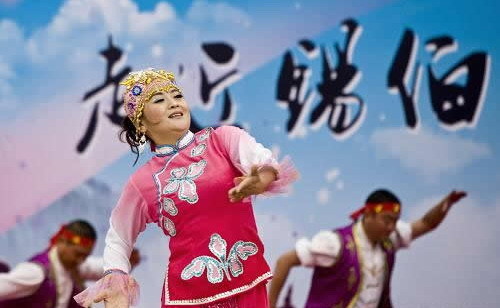
The Festival of Westward Movement is a day to commemorate the westward movement of the Xibe ethnic group to guard border areas. As it falls on 18th of the fourth month in lunar calendar, it is called "the Four-one-eight Festival", or Family Remembrance Day for the people to express their homesickness. Every year on that day, the Xibe people in Xinjiang will gather for a picnic, performing dances to commemorate the heroic deeds of their ancestors in garrisoning the border.
|
 |
The Festival of Westward Movement, with a history of over 200 years, is a traditional festival celebrated by Xibe people, whose forefathers had lived their lives on the Songnen Plain and Hulunbuir Grasslands before the 16th century. According to data, on 18th of the fourth lunar month in 1764 (the 29th year during the reign of Emperor Qianlong), a total of 3275 Xibe people, including 1018 government officials and soldiers together with their families, were called up by the Qing government from Shengjing (today's Shenyang City) heading for the Yili area of Xinjiang to cultivate and guard the border areas. On that very day, those about to leave gathered in Taiping Temple (their ancestral temple) in the city with those to stay, sacrificing their ancestors and having a farewell dinner. Then led by Manchu officials the next morning, they set their foot on the long journey to the Yili area, which took them a year and five months.
Ever since then, April 18 of the lunar month each year is celebrated with sacrificing activities in temples, where meat and brown rice are prepared for each household commemorating the great deeds done by their ancestors in moving westward and guarding the northwest borders of China. It is also a time to recall their fellowmen in their hometown.
In order to commemorate this historical event, Xibe from near and far gather on this day to hold various activities, hence the West Moving Festival.
On this day the Xibe make flour or bean sauce to mark the successful conclusion of their ancestors' westward move. Celebration activities include picnicking, archery, martial arts contests, singing and dancing. The singing performance that centers on the contents and scenes of their ancestors' move west is a unique part of the festival.
Men and women, old and young, all in their best attire come from far and near, singing and dancing to the joyous rhythms, to express their yearning for their hometown and longing for a better life in the future.
Xibe Ethnic Group
In China, there are 188,824 (in 2000) people who fall under the ethnic group category of Xibe. Most live in the fertile areas along the Ili River in northwestern Xinjiang, especially in the Ili Kazak autonomous prefecture's Qapqal Xibe autonomous county and the Huocheng and Gongliu counties along the Ili River. The rest are scattered over such areas as Shenyang, Kaiyuan and Yixian in northeastern China.
Originating from different geographical and historical backgrounds, the Xibe people in the northeast and northwest have developed vastly disparate lifestyles. Those in the northeast have become increasingly similar to the local Han and Manchu in cultural areas such as language, costumes, food and in their general style of living. On the other hand, those living in compact communities in Xinjiang have not strayed far from their own customs.
| ?
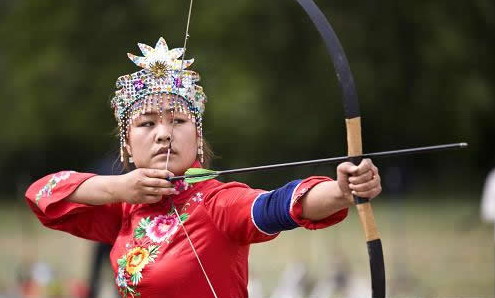 In early times, the Xibe people mainly engaged in hunting and fishing. |
The Xibe people believe in religions known as Shamanism and Lamaism. They also have their own language and characters.
In early times, the Xibe people mainly engaged in hunting and fishing. With a developing economy, they also turned to agriculture and trade. The Xibe people depend on rice and wheat as their staple food, but also favor naicha (tea with milk), ghee, mutton and beef. Eating dogs is forbidden in their diet.
The traditional dress of the Xibe ethnic group is basically equivalent to that of Manchus. Men often wear long robes or short shirts and women wear cheongsam with laces mounted in the laps or cuffs. Today most Xibe people have adopted Han fashion and only some elders in Xinjiang maintain the traditional dress.
The Xibe people excel at singing and dancing. They are especially adept at playing their musical instruments, the Dongbuer and the Maken (harmonica). Xibe men are skilled archers. At festivals, sport activities such as wrestling, toxophily, horse racing, sheep-tossing and weight lifting are staged.