Canadian novelist taps into Tang Dynasty
By Wendy Qian (China Daily)
Updated: 2010-06-28 09:20
 |
Large Medium Small |
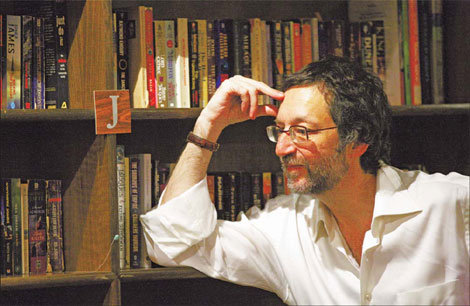
This month, Canadian fantasy novelist Guy Gavriel Kay arrived in China, a country he has been researching and writing about for seven years.
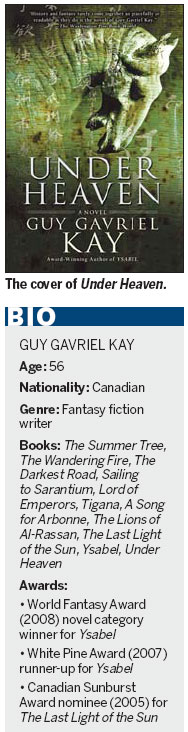
His new novel, Under Heaven, a page-turner based in the Tang Dynasty (AD 618-907), was recently published and Kay toured North America for two months promoting the book. Now, he is enjoying the "pleasure to be in the country that inspired Under Heaven".
On Wednesday evening, Kay promoted his novel at the Bookworm. On Friday, he attended an academic gathering with his Chinese publisher, other fantasy writers and literary scholars.
Despite Kay's busy schedule and daunting mission to talk about similar subjects over and over while on book tours, he said the discussion in Beijing was exciting.
"One of the interesting aspects of doing book-related appearances in other countries is to see what doesn't change among readers - and what does," he said on his blog.
Beijing readers showed interest in how Kay balances history and fantasy, a question that contributes to the main charm of the Toronto-born's works.
Kay, who has already published 11 books, found his new inspiration from outstanding Chinese literature and Tang poetry.
Among the Tang poets that inspired him were Du Fu, Li Bai, Bai Juyi and Wang Wei.
The poem that inspired the beginning of Under Heaven was Du Fu's Ballad of the Army Cart:
"A son is born only to die, his body lost in the wild grass The white bones lie there in drifts, uncollected.
New ghosts complain and old ghosts weep, under the lowering sky their voices cry out in the rain."
Kay said that when he first read the English translation of the poem, the Chinese translator noted that his father had paid shepherds to collect the bones of dead soldiers from hundreds of years ago.
The thought that a man in the modern era still cared for soldiers in the way Du Fu did hundreds of years ago, motivated Kay to write a fantasy novel based in the Tang Dynasty.
"[The historical period] is almost overwhelming. The entire culture obsessed me for seven years," he said, adding that he encourages people to read the history of Tang Dynasty, the poets and "the world they shape for you".
Kay's major concern is mastering the right balance between fiction and reality.
"Over the last six or seven of my books, I have grounded them very strongly in research," he said.
For Under Heaven, he researched extensively and corresponded with Eastern Studies academics around the world.
"After reading their books and articles I would write to them to get more information," he said.
"I really enjoy deciding what I'm going to work with in a given book, spending years reading, making notes, corresponding. I love that part of doing the book."
Although the novel draws upon the tragedy of the An Shi rebellion in the 8th century and includes many real world details, most of the main characters, such as the Shen family, are invented. The important historical figures are included, but they "inspire characters in the book."
"I don't want to give you a character who is Li Bai, or Henry the Eighth of England and put words in their mouths," Kay said.
Instead, he wants readers to be aware of the fact that "we can't know what the real people thought and said in their private moments".
Furthermore, this is not only because Kay wants to respect and honor an astonishing period of history; he also does not want to be restricted by reality during his creative process.
In the Author's Letter within Under Heaven, Kay wrote: "'Spinning' the story a little towards an invented setting and characters feels ethically valid and creatively liberating. A win-win."
Still, the novel was influenced by Chinese culture, bearing Eastern themes such as female's hidden political power and the courtesan culture.
Film agents are beginning discussions now about the possibility of setting any filming of Under Heaven in China.
"I have great admiration for Ang Lee, Zhang Yimou, they are enormously talented Chinese directors," Kay said.
Versions of two of his earlier novels were published in China last month with Chinese text. Kay said he will further discuss translation details for Under Heaven during this trip.
When asked about the rough idea for his next novel, Kay said: "We'll see."
?