The way to Wudang
|
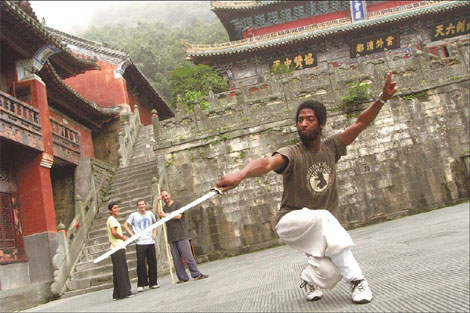
American Raphael Robert Zanders-McNeil practices Wudang jianfa at the Wudang Taoist Kungfu Academy on Mount Wudang, Hubei province. Photos by Zhu Linyong / China Daily |
Hubei province's Mount Wudang is a Mecca for Taoists and martial arts pilgrims keen to learn the way of the fist and tai chi, Zhu Linyong reports
Summer is the best season to experience Mount Wudang, a mist-shrouded Taoist Mecca in central Hubei province. Most visitors arrive in the morning, pay homage at the Taoist monasteries, climb a stairway to the awe-inspiring Golden Palace on the mountain peak, and leave at dusk.
A handful choose to stay for a night or two, so as to enjoy a more relaxed tour of the scenic spots.
Fewer still, such as Elizabeta Skuber Osterman, a Chinese studies expert from Slovenia, stay longer to experience the natural beauty of the mountain, Taoist culture and the legendary Wudang kungfu.
Osterman has been training at the Wudang Taoist Kungfu Academy since April.
The 21-year-old Wudang kungfu training center near Purple Heaven Palace is the largest and best-preserved Taoist compound on the more than 1,600-meter mountain, which is the headquarters of the Wudang Taoist Association.
Under the leadership of the association, the organization has drawn increasing attention from kungfu enthusiasts seeking an alternative destination to the Shaolin Temple in central Henan province.
Osterman's one-month stay at Wudang was a 60th birthday present from her son, daughter-in-law and friends in 2009.
"I had a great time, lots of exercise, Taoist philosophy and meditation under the tutelage of such kungfu masters as Guan Yongxing and Li Tengfei," says Osterman, who visits again this summer.
|
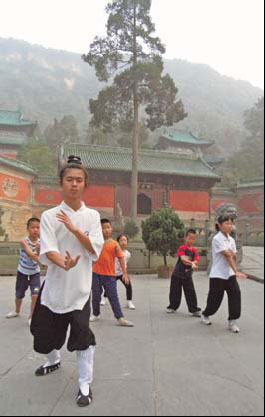
Taoist kungfu teacher Ming Zhengwang guides a special class for kids. |
The daily routine included a morning Taoist scripture chanting session at 5:30 am in the temple, morning and afternoon training sessions in Wudang tai chi, and Taoist lectures in the early evening.
She also learned traditional Chinese healthcare from Taoist doctors such as Wang Taike and Zhu Huaying; and learned to play the guqin, the seven-stringed, plucked Chinese instrument, from Taoist nun Fang Chongyi.
She describes Wudang as a "holy land" of "extraordinary Taoist kungfu masters, magnificent natural beauty, pure-hearted nuns, warm-hearted priests, as well as refreshing vegetarian foods".
In Osterman's view, Taoism is not just a metaphysical theory but a better way of life.
"Being modest, natural, retaining tranquility and purity of the heart are the greatest treasures that I have received by studying Taoism and practicing Taoist kungfu," she says.
Jackie Sheargold, a massage therapist from New Zealand, shares the same passion as Osterman.
She has visited the academy for five consecutive years, to improve her tai chi skills.
Back home, Sheargold has practiced qigong, and tai chi for at least 10 years, and has used Traditional Chinese Medicine (TCM) to help cure her clients.
"I have progressed to the point that I am really enjoying Taoist philosophy and I'm trying to incorporate it into my life," she says.
For Raphael Robert Zanders-McNeil, a Chinese language major from San Francisco, learning Wudang kungfu has been a dream since he was a teenager when he watched a movie featuring Wudang Taoist warriors.
Zanders-McNeil has been practicing Chinese kungfu for about 10 years. His focus is Wudang jianfa, or Taoist sword techniques.
Besides the demanding routines that include "lots of kicks and difficult stances", he studies the Tao Te Ching, the supreme Taoist canon, and books about Ba Gua Zhang Boxing, a sub-branch of China's Taoist kungfu.
Asked about the benefit of practicing Wudang kungfu he says it benefits the development of one's character and body.
"Physically, you can stay healthy. It keeps your mind focused and gives you a clear awareness of your body and the environment, and of yourself and others."
Although Taoism behind Wudang kungfu is ancient Chinese wisdom, Zanders-McNeil insists that it is relevant to his life.
"The Taoist ideas have a universal meaning. It does not matter whether you come from the East or the West," he says. "If more people were exposed to the Taoist approach, the world would be a better place."
Bjarte Simon Hiley, a young man from Norway, is on a mission. When he was young, Hiley began practicing kungfu under the guidance of his mother and has studied under many kungfu masters.
His mother, Pamela Hiley, the director and founder of Norsk Taiji Senter, in 1983, is widely considered to be one of Europe's most experienced tai chi and qigong instructors and the first professional instructor of kungfu in Norway.
"In Norway, more and more people are interested in learning kungfu, especially tai chi," he says. "Every week, hundreds of students come to learn from my mother at the Norsk Taiji Senter."
A graduate of Beijing Sports University's wushu department, Hiley has for three straight years learned a wide variety of Wudang kungfu skills, both bare-fist and weapon skills. The Ba Xian Gun, or Eight Immortals Staff, is his favorite item.
"My goal is to become an invincible warrior who fights and wins using the tai chi principle - sending back the energy of my enemy to beat him," he explains, adding he will assist his mother when he finishes his studies.
Aside from drawing foreign enthusiasts, the academy also holds a spell over locals who are thirsty for time-tested knowledge and skills such as Taoist ideas and Wudang kungfu.
For instance, each summer, Deng Yinglong, a travel service manager from Yichang, Hubei province takes at least two months off to head for Mount Wudang and "special treatment for body and soul".
The 34-year-old has been intrigued by the poetic and mysterious Wudang kungfu since he saw a TV show three years ago featuring a Wudang tai chi performance by Taoist priests.
This time, Deng took his 5-year-old daughter Deng Yiling, who attended a special class for kids, guided by young Taoist kungfu teacher Ming Zhengwang.
"I am not a lay Taoist practitioner. But I like the atmosphere here very much," says Deng who increasingly feels it is "an indispensable part of my life to have a brief, annual escape from urban life".
|
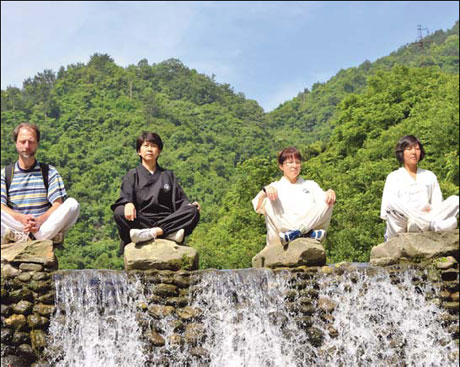
Four foreign Taoists sit for meditation in Xiaoyao Valley on Mount Wudang. |
(China Daily 08/24/2010 page18)