New moms get enough sleep, just not good sleep
(Agencies)
Updated: 2010-08-31 09:04
 |
Large Medium Small |
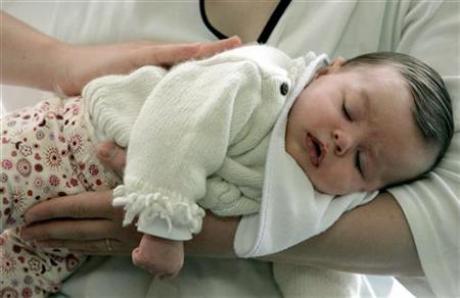
Contrary to popular belief, new mothers may often get a decent amount of sleep in their babies' first few months -- but it's not a good-quality sleep, a new study suggests.
The study, which followed a group of new moms, found that on average, the women got just over 7 hours of sleep per night during their babies' first four months. That is within what's generally recommended for adults, and, based on past studies, more than the average American gets.
On the other hand, the study found, that sleep is also frequently disrupted -- with the women typically being awake for a total of two hours overnight.
The finding may not sound surprising, especially to parents. But the study does challenge a central assumption about new mothers' typical sleep patterns, according to lead researcher Dr. Hawley E. Montgomery-Downs, an assistant professor of psychology at West Virginia University in Morgantown.
That assumption, she told Reuters Health, has been that most new moms are sleep-deprived -- that is, not getting enough hours of sleep.
So the advice on how to combat daytime fatigue has focused on countering sleep deprivation, Montgomery-Downs said -- such as the age-old adage to "nap when your baby naps."
But the current results, reported in the American Journal of Obstetrics & Gynecology, suggest that new mothers' highly fragmented sleep is what's behind their daytime fatigue.
That sleep pattern, Montgomery-Downs said, is similar to what's seen with certain sleep disorders, such as sleep apnea, where people log enough hours in bed, but get little restorative, good-quality sleep.
Sleep occurs in repeated cycles that each last about 90 minutes to two hours. Depending on how often a new mom is waking up, she may get few or no full cycles of sleep, Montgomery-Downs noted.
And a quick daytime nap is unlikely to counter that.
"We need to think about what kinds of strategies can help consolidate sleep" for these mothers, Montgomery-Downs said. One tactic, she suggested, could be for breastfeeding moms to find time to pump milk and store it in bottles so that they do not have to be the ones to always get up with the baby.
And while quick naps might not do much, Montgomery-Downs noted that "if you're one of the lucky parents" whose infants typically nap for at least two straight hours, taking that time to sleep could be helpful.
The findings are based on 74 new mothers who were followed between either the second and 13th week of their infants' lives, or between the 9th and 16th week. The women kept track of their sleep patterns using sleep "diaries," and also wore a wristwatch-like device called an actigraph that recorded their movements during the night.
Contrary to expectations, the researchers found that the women's average sleep time was about what it should be, at 7.2 hours. Instead, sleep fragmentation was the issue.
Relatively few mothers tried napping as a countermeasure. By the third week of their infants' lives, less than half of the women in the study said they napped, and among those who did, the average was twice per week.
Daytime fatigue, a problem reported by many new mothers in other studies, is a concern for several reasons, according to Montgomery-Downs. One is that, in some women, sleep problems and exhaustion may contribute to postpartum depression.
Beyond that, Montgomery-Downs said, fatigue can also hinder people's ability to drive safely or hurt their performance at work.
She argued that mothers' fragmented sleep and daytime fatigue call for a reconsideration of maternity work leave in the U.S. Right now, national policy states that workplaces with 50 or more employees have to offer up to 12 weeks of unpaid leave; the U.S. is the only Western country that does not mandate some amount of paid parental leave.
So many women, Montgomery-Downs said, may have to go back to work at a time when "they should really be taking care of themselves."