Food for thought
Public interest in medicinal cuisine has fueled the growth of restaurants proffering foods that offer health benefits, but often without the guidance of experienced cuisine masters. Ye Jun reports
A warming bowl of lamb soup with ginger and Chinese angelica is a classic Chinese recipe for people who feel cold and tired in autumn and winter.
Chinese angelica is an often-used traditional herbal medicine. Its warming capacity is used to stimulate blood circulation, while ginger dispels coldness, warms up the inside of the body, and promotes perspiration. Lamb has a hot, warming property that replenishes energy for the weak.
This recipe was first drafted by Zhang Zhongjing, one of China's best-known traditional medicine doctors in the Eastern Han Dynasty (AD 25-220).
About 1,800 years later, this soup is still prescribed during the cold seasons for people with a weak constitution, especially old people and women after delivery.
"The public has a compelling desire to restore health through healthy food," says Sha Fengtong, deputy director with China Association of Health-Protecting Food. "But with that has come more problems."
A good example is ginseng - widely popular not only in China, but also in Korea and Southeast Asian countries as a daily energy booster. The valuable herb is used to replenish qi and sooth nerves among people with a weak constitution. But it has been found that, for people with weak yin and excited yang, ginseng can lead to dizziness, overexcitement and even mania.
Some other commonly used herbs in food can also have adverse properties. Saffron, which invigorates blood circulation and boosts immunity, can cause miscarriages, dizziness and overexcitement. Huangqi, or milk vetch root, replenishes energy but can be dangerous for people who've had a cerebral haemorrhage.
The China Association of Health-Protecting Food is a nonprofit social group supervised by the State Administration of Traditional Chinese Medicine. It has compiled and published the Basic Requirement on the Professional Qualification and Making of Medicinal Foods.
"We hope the Requirement will get proper publicity and recognition," Sha says. "Restaurants making medicinal foods should get recommendations from China Association of Health-Protecting Food and instruction from experienced cuisine masters. But we expect that to be a gradual process."
The Requirement is an instructional policy, instead of a legally binding requirement, Sha adds.
However, according to the preface to the Requirement, Chinese society is undergoing an enhanced public awareness in health and well-being, and interest in traditional Chinese medicine (TCM) as well as medicinal cuisine has increased. With the result that related enterprises and restaurants proffering foods with health benefits are "sprouting like bamboo shoots after spring rain", it says.
|
 |
But there have been "nonstandard" practices that draft up medicinal foods regardless of customers' physical condition, which could cause health problems, it cautions.
The Requirement suggests restaurants should have TCM doctors as instructors and experienced chefs in food and herb combining to prepare "medicinal cuisine". It also requests that ingredients used in medicinal foods should be those designated in a list issued by the Ministry of Health in 2002, and that the quantity of herbs used should not be more than those designated in the Pharmacopoeia of the People's Republic of China.
The Ministry of Health list includes more than 80 foods that can be used both as food and medicine, more than 110 herbs used for health and 59 ingredients forbidden in foods for health purposes. Most of these are herbs, while a small number are derived from animals. Last year, the Ministry of Health announced that aweto, a rare fungus believed to have a replenishing function, is not recommended for ordinary food products.
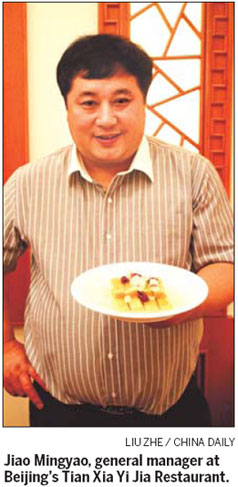
Jiao Mingyao, general manager at Beijing's Tian Xia Yi Jia Restaurant, says that ginseng has already faded out of restaurants, but aweto still exists on quite a few menus.
"Plenty of restaurants are unwilling to accept the ministry's recommendation," says Jiao, a national-level cuisine master. "While the ministry defines it as a rare herbal medicine, to restaurants, aweto is just a fungus."
The difficulties are especially obvious for restaurants and families in South China, where people grow up drinking nutritious soups with herbs in them. Duzhong, or eucommia bark, for instance, is cooked in soup with pork kidney to replenish energy in men's kidneys. Ginseng, angelica and lily bulb are boiled together to replenish energy, and benefit the lungs.
Other common ingredients used as foods and herbal medicines include Chinese jujube, lotus seed, medlar fruit, longan and gastrodia tuber. The fresh leaves of mint, basil, milk vetch and baical skullcap are also being used in dishes, according to Jiao.
Jiao recommends eating nutritious foods according to different seasons, individual physical conditions and location.
He says foods that raise energy in spring include sprouts and the liver of chicken, pork and lamb to replenish energy in the liver.
"Summer is a time to replenish energy mildly, and dispel heat and dryness," he says. "It is good to eat lotus seed, mint, water chestnut, pigeon, beef and duck."
For autumn, he suggests frying lily bulb with gingko, and making dishes with orange and pear. In winter, beef and lamb, as well as venison are all good energy boosters, he says.
"My concept of medicinal food is about scientific, nutritional cooking," Jiao says. "It should be an advanced phase of development for Chinese cuisine, instead of a simple mixture of herbal medicine and food."
Jiao thinks people should divide medicinal ingredients into those with light medicinal properties and those with strong medicinal properties, which should only be prescribed by doctors.
"Those herbal medicines that can be mixed with foodstuff to treat illnesses should be left for doctors to decide," he says. "As to those that are also foodstuff, people should be reminded of their side effects, but they should not be banned from using them."