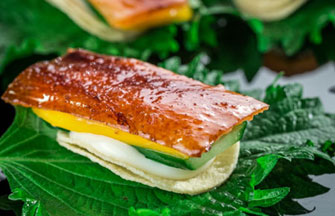
Chinese chopsticks
Introduction to Chopsticks
Chopsticks are a pair of sticks, usually made of wood, used for eating Asian food. In Chinese, the old word for "chopsticks,",and also in some varieties of modern Chinese such as Hokkien, was zhù (箸 Pinyin:zhù, Minnan: tī). However, using the word “zhù” became a taboo on ships because it sounded the same as another word meaning "to stop" (住). Consequently, it was replaced by a word of opposite meaning, kuài (fast, quick), which evolved into the current term, “kuàizi.” This gradually spread until it became the word for "chopsticks" in most varieties of modern Chinese. The character for this new meaning of "chopsticks" (筷) for kuài has the radical for bamboo added to the character meaning "fast" kuài (快). The English term, “chopsticks,” is supposedly derived from the Pidgin English spoken in British Chinese colonies. The Chinese term, “kuai-tzu,” or “quick ones” became chop (Pidgin for “quick”) sticks.
|
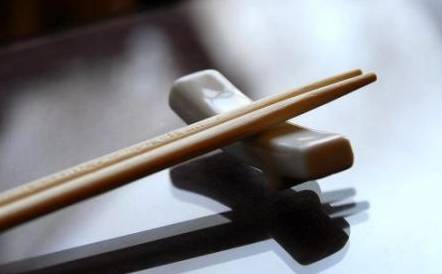 |
Chopsticks come in many different forms. Bamboo tends to be the most popular material from which to make them. There is plenty of bamboo in Asia, and it is easy to split and extremely resistant to heat. Other popular materials have included wood and bone, and chopsticks made of precious metals were not uncommon among the wealthy in ancient times. It was believed that silver chopsticks would turn black upon contact with poisoned food, although this has since been disproven by modern science.
It is believed the first chopsticks were developed over 5000 years ago in China. The earliest evidence of a pair of chopsticks made out of bronze was excavated from the Ruins of Yin near Anyang, Henan, dating back to roughly 1200 B.C. Early Asian man would retrieve his food from the fire using sticks or branches broken from trees. Later, as the population grew and resources became scarce, people would cut food into smaller pieces to save fuel because the smaller portions cooked faster. This eliminated the need for knives, and chopsticks became the utensils of choice. The onset of Confucianism is believed to have further cemented the use of chopsticks as the primary Asian eating utensil. Confucius taught, “The honorable and upright man keeps well away from both the slaughterhouse and the kitchen, and he allows no knives on his table.” Confucius’ disdain for the presence of knives at the kitchen table, coupled with the popularity of his teachings no doubt contributed to the expanding use of chopsticks among the population.
By 500 A.D., chopsticks had spread from China to other countries such as Korea, Vietnam and Japan. While originally only used for religious ceremonies in Japan, chopsticks quickly gained popularity there as well, and in no time their use became as widespread there as in the rest of Asia. Soon chopsticks evolved into an important icon of Asian culture and an important part of history.
How to Use Chopsticks
1. Pick up the first chopstick with your middle finger and thumb. Stiffen your hand for a firm grip. Have the broad end of the chopstick lay on the part where your thumb and index finger connect. Rest the narrow end on the tip of your ring finger, and hold it in place with the tip of your middle finger. (Hint: try holding it the way you hold a pen to write. It might rest on your ring finger or your middle finger, held in place by your index finger. Hold the first chopstick behind your thumb, and then lift your index finger so it can hold the second chopstick.)
|
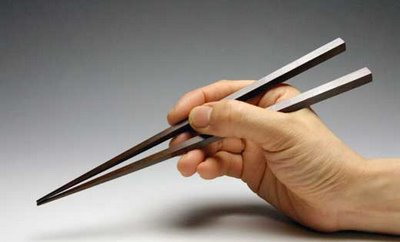 |
2. Grip the second chopstick with your index finger. Place your thumb over the second chopstick. Adjust your grip whatever position is most comfortable for you. Make sure the narrow tips of the chopsticks are even with each other to help prevent them from crossing or being unable to "pinch" the food.
3. Hold it steady. This chopstick should not move when you attempt to pick up food. Alternatively, hold the first chopstick steady and move the second (top) chopstick by moving the tip of your index finger up and down while the thumb remains relatively steady, acting like a pivot point. The top chopstick should remain pressed to the index finger from the tip through the first joint. The movement should come from flexing the joint closest to the knuckle. Straightening your index finger opens the chopsticks and bending it closes them, with perhaps a slight flexing of the thumb to keep the chopsticks lined up with each other. (Note: this alternative is different from the photos on how the top chopstick is held. The movement comes from the top chopstick, not the bottom one, so the top chopstick is held so that it can be moved easily. Use the method that is most comfortable for you.)
4. Practice opening and closing the chopsticks. Make sure the broad ends of the chopsticks do not make an "X," as this will make it difficult to pick up food.
5. Pick up food at a good angle (try roughly 45 degrees from the plate), and gently lift it up. If it feels unstable, put it down and try again.