Smugglers plunder the fossils of Peru
By Simon Romero and Andrea Zarate (China Daily)
Updated: 2010-12-20 10:17
 |
Large Medium Small |
 |
|
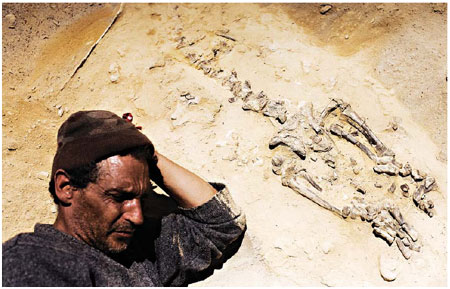
The Ocucaje Desert contains troves of marine fossils. Mario Urbina-Schmitt rested next to a fossilized skeleton of a seal. Traffickers sell the prehistoric treasures, which are found in desolate areas like those below. [Photo/Moises Saman/The New York Times] |
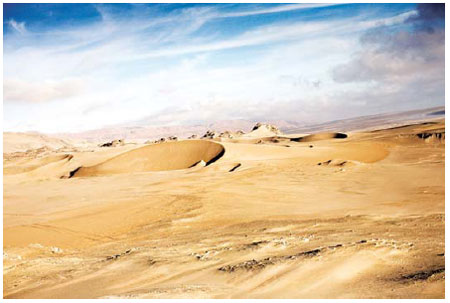
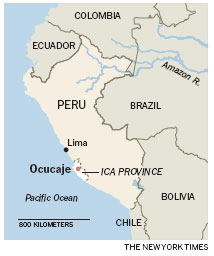
But to the bone hunters who stalk the Ocucaje Desert each day, the punishing winds here have exposed a medley of life and evolution: a prehistoric graveyard where sea monsters came to rest 40 million years ago. These parched lands, once washed over by the sea, guard one of the world's most coveted troves of marine fossils, a trove now threatened by smugglers.
Discoveries here include gigantic fossilized teeth from the legendary 15-meter shark called the megalodon, the bones of a huge penguin with surprisingly colorful feathers and the fossils of the Leviathan Melvillei, a whale with teeth longer than those of the Tyrannosaurus rex, making it a contender for the largest predator ever to prowl the oceans.
"This is perhaps the best area in the world for marine mammals," said Christian de Muizon, 58, a paleontologist at the Natural History Museum in Paris who led an expedition here in November. He ranks the Ocucaje and adjacent sections of desert with top fossil areas like Liaoning Province in China, where ashfall preserved plumed dinosaurs.
But beyond the boon to science, the discoveries here have attracted the attentions of another class of fossil hunters as well: smugglers. Officials in the capital, Lima, say seizures of illegally collected fossils are climbing.
Peru is astonishingly rich in archaeological and paleontological sites, so much so that the issue is part of a delicate political debate here. The loss of national treasures to collectors from abroad has set off concerns about sovereignty, perhaps best exemplified by the feud between Peru and Yale University in the United States over Inca artifacts taken by Hiram Bingham, the American explorer typically credited with revealing the lost city of Machu Picchu to the outside world a century ago.
For now, the Ocucaje remains open to just about anyone who wants to search for fossils here. Peruvian law, while vague, classifies fossils as national patrimony and requires fossils found in the country to remain in Peru, unless special permission is granted.
But enforcement and preservation here seem like a distant dream. The government controls the desert but leases parts to mining companies, which could damage or destroy fossils. Looters have already ravaged archaeological burial sites on the desert's fringes. The police rarely even enter the area.
An assortment of fossil hunters have their own visions of how the Ocucaje should be managed. One comes from Roberto Penny Cabrera, 54, a former naval officer who says he is a descendant of Jerónimo Luis de Cabrera, the conquistador who founded the nearby city of Ica in 1563.
Mr. Penny Cabrera, who guides both backpackers and paleontologists into the Ocucaje, contends that some of the fossils should be left in the ground. Another option, he said, would be to create a museum - not in Lima, much less Berlin or Paris - but in Ica.
On the streets of Ica and nearby towns, visitors can already see such fossils - and buy them. Merchants sell fossilized shark teeth, about the size of a man's hand, at prices from $60 to $100 apiece. They say other fossils are available, at higher prices.
Meanwhile, seizures of illegally obtained fossils are increasing, surpassing 2,200 this year, compared with about 800 last year, largely at Lima's international airport, said José Apolín of the Ministry of Culture's office of recovery.
Sometimes officials stumble upon large fossils by chance; in 2008 the police found a jawbone thought to be that of a mastodon in the cargo hold of a bus.
The fossil hunters sometimes even turn on one another. In 2008, Mr. Penny Cabrera pushed for the authorities to arrest Mario Urbina-Schmitt, 48, a well-known researcher for Peru's Natural History Museum, while he was working with a French paleontologist, Gilles Cuny.
Mr. Urbina-Schmitt, who faces time in prison if convicted on charges of illegally removing fossils, said the case against him was absurd. He also said the focus on his case had shifted attention away from other episodes, like a 40-million-year-old whale fossil spirited out of the desert. "My crime is that I do good work," he said.
The debate over trafficking aside, paleontologists say the prized fossils of the Ocucaje remain vulnerable to yet another factor: erosion.
"If we leave them in the desert," Mr. de Muizon said of the Ocucaje fossils, "they will be dead for the second time."
The New York Times