Travel
Steeped in history
By Chitralekha Basu (China Daily)
Updated: 2010-12-30 08:08
 |
Large Medium Small |
|
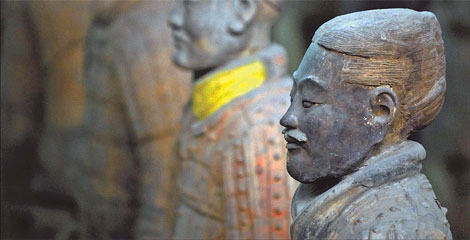
The 2,200-year-old terracotta warriors are the biggest draw of Xi'an, Shaanxi province, which is replete with a wealth of historic relics. Xie Zhengyi / For China Daily |
|
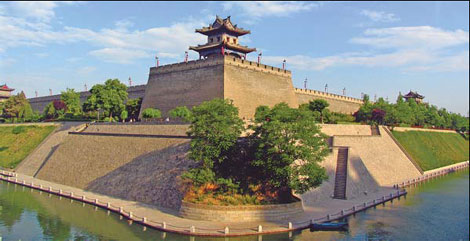
The 13.7-km-long city wall offers a vantage view of how the ancient city has grown. Xu Baoping / For China Daily |
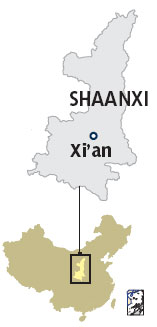
The ancient capital of Xi'an is not all terracotta warriors, Chitralekha Basu discovers
What do you make of a city that is witness to more than 3,000 years of Chinese history (during 1,100 years of which it was served as the national capital), if you had just a weekend in hand? It's difficult making one's way around Xi'an without bumping into antiquity. The hub of culture at the height of the Tang Dynasty (AD 618-907) and the nodal point from where the Silk Road originated in the East during the Han Dynasty (206 BC-AD 220), Xi'an is so replete with pagodas, tombs and ancient streets, a first-time tourist could well feel like a 5-year-old in a candy store. Here's our pick of Xi'an's finest:
Terracotta Warriors and the First Emperor's Mausoleum
It's a bit like the Mona Lisa. At first glance the 1,000-odd terracotta warriors lined up in neat files in Pit 1 might fall short of the tremendous build-up.
The gravitas, determination and unwavering allegiance carved on each unique visage might not register immediately from behind the iron rails cordoning off the pits. The soldiers are way down below, a little too distant to detect the remnants of the chipped lacquer on the armor and the precise folds of the bow tied under a mustachioed general's chin.
Therefore, tarry a while. Get acclimatized to the constant swirl and eddy of tourists. Allow the rays of the afternoon sun to gently glide over the figures, one by one, bringing to light the individual character chiseled on each face - stern, determined, reticent, eager, becalmed and, always, inscrutable.
China's first emperor, Qin Shihuang (259-210 BC), wanted to replicate the entire gamut of the kingly paraphernalia that he was used to in his temporal life, so that he might take these to his next, buried with his mortal remains in his mausoleum.
The tomb, a pressed-down pyramid with a wide base (about 12,000 square meters) - now under an intense green cover - is less than one kilometer away from the terracotta warriors' museum site. It might seem like a never-ending mound, etched against the faint outline of the Lishan mountain range. But the majesty and solemnity of the site under which China's first emperor lies is simply overpowering.
Huaqing Hot Spring
The blurry outline of Lishan mountain comes into better focus from the Huaqing Hot Spring enclave; the cable cars carrying people to the peak above add a contemporary feel to the pagodas, frescoes, giant urns and steaming pools beneath.
In 1936, Kuomintang leader Chiang Kai-shek (1887-1975), who was staying in his private quarters in the picture-perfect gardens of Huaqing Palace, took refuge in those very hills from where the men of Chang Hsueh-liang, a warlord and a former ally of Chiang's, captured him, inviting the Chinese Communist Party leaders to decide his fate.
The tremors that incident sent across the world can hardly be gauged by looking at the rooms, where Chiang's portraits and personal effects are kept.
|
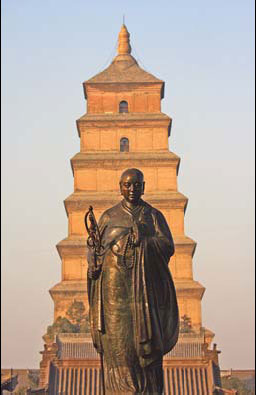
A bronze statue of Tang Dynasty monk Xuanzang in the Big Wild Goose Pagoda. Xu Hongyun / For China Daily |
By contrast the elaborate bath houses that Emperor Xuanzong (AD 685-762) built for his favorite concubine Yang Guifei - where the tubs came in quaint floral shapes - are a reflection of the grandeur and opulence of the lives of Tang Dynasty monarchs.
Hot air curling up to the beams would condense into frost, engineered by a home-bred scientific invention, in the Frost Flying Hall, where the emperor and his ladylove would retire for the night. The giant cedars and the persimmon trees leaning over the still waters of the expansive artificial Nine Dragon Lake bear testimony to a time when emperors infused style with a quiet dignity.
Xi'an City Wall
The greatest reward of going up on the ancient city wall is that it offers a vantage view of how the city has grown. In the immediate vicinity of the south gate are the gray-black pagoda-roofed traditional Chinese courtyard houses.
As one walks eastward these are increasingly replaced by barrack-style residential blocks with dish antennae and solar cookers sprouting from the rooftops. Beyond the surrounding moat are the green patches - thronged by skateboarders, musicians and tai chi dancers - hemmed in by the skyscrapers.
You can bike around three-fourths of the ramp (a section near the north gate is closed for renovation), which in its entirety measures 13.7 km, ride in tandem, or hop into a golf cab.
When you have had your fill of this edifice, built by Ming emperor Zhu Yuanzhang (reign 1368-1398) - actually a restored and extended version of its Tang Dynasty predecessor - peeped out of its numerous crenellations, soaked in the information about the weapons on display and admired the three-tiered red lanterns hung every five meters or so, go down and head toward Bell and Drum towers, located at the pivotal point of this quadrangle.
The Great Mosque and Muslim Street
A range of delectable street eats can be found near Drum Tower. Hua Yan / For China Daily
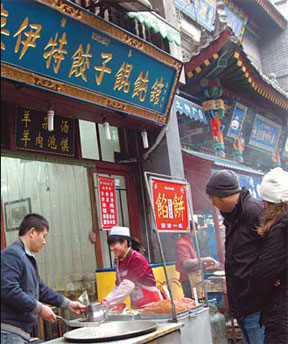
A five-minute walk down an alley - bursting at the seams with sequined dresses, tawdry scarves, jewelry and kitschy souvenirs - northwest of the Drum Tower will take you to one of the oldest mosques in China.
Built in AD 742, and spread over a 12,000 sq m manicured garden, the mosque looks more like a typical Chinese courtyard house, with steles sporting beauteous inscriptions by renowned Song Dynasty (960-1279) artists. The Islamic element is apparent in the sound of the chant at prayer times, as also in the stores outside, selling prayer mats, skullcaps and deftly executed calligraphy.
This is also the place to tuck into a range of delectable street eats. Friendly Hui men and women, heads covered in long, thin scarves, dole out sizzling pieces of pork or beef in a coating of ground wheat, a variety of aromatic soups, glutinous rice coated with nuts and orange-colored persimmon cakes.
Big Wild Goose Pagoda
You could be forgiven for losing yourself in the sylvan surroundings of the Big Wild Goose Pagoda, dotted with steles, rock gardens, stone images of the Buddha, carved in relief, and ancient trees, staggering under a web of prayer envelopes.
Built in AD 652, to store the Buddhist scripts the monk Xuanzang brought back from his trip to India, the seven-tiered pagoda is a monument to a grand translation scheme that sealed the beginning of a Sino-Indian relationship.
A total of 1,335 texts were translated from Sanskrit to Chinese under the patronage of Tang emperor Gaozong and still form the bulwark of Buddhist studies in China.
An imposing bronze statue of the monk who traveled across the Orient for 17 years to initiate this cultural exchange stands in front of the temple premises.
The pagoda, at 65 meters, stands like a beacon. A view from any of its arched windows helps illuminate the imprint of several generations of kings, scholars, craftsmen and visionaries that Xi'an bears today.
(China Daily 12/30/2010 page19)