Getting in touch with the people
|
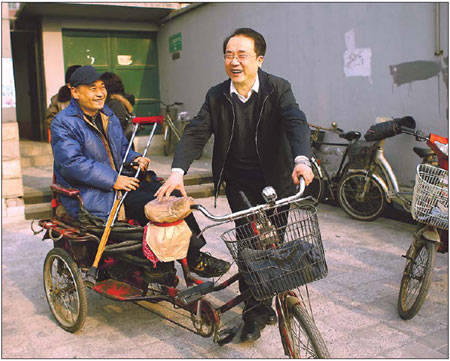 Wu Bing, director of Xiaoguan community in Chaoyang district, smiles as he assists a local. Zou Hong / China Daily |
Being in charge of a Beijing community is a particularly tricky profession. Because of the large degree of responsibility, community leaders must be patient, observant, and above all, communicative. Liu Yujie followed Wu Bing, director of Xiaoguan community in Chaoyang district, around for the day.
7:30 am: Morning patrol
After dropping his suitcase off at the office, Wu hits the streets on his morning patrol. The focus is to check the community for general hygiene.
On this day, the stairs outside the Guilin Rice Noodle restaurant are oily and rubbish has been left unattended.
"The bikes outside KFC are always in a good order and the store looks clean and tidy," he says. "Why can't Chinese fast food stores display the same high quality of management?"
Wu makes a note to bring up the issue at the routine meeting.
"Only by keeping the streets clean and stores reliable can residents live here happily."
Wu says the community office has launched a grading system to evaluate store performances, with awards that include daily necessities like rolls of tissues and detergent.
"They are useful for small businesses that are suffering from a slow circulation of currency," he says.
8:20 am: Breakfast
In China there is a special semi-governmental body of community offices that runs almost everything connected with an administrative district, such as local livestock insurance, economic development and even entertainment activities for residents.
Wu heads back to the office for a spot of breakfast. While he eats, Wu flicks through a newspaper to find out what has happened in Beijing and the rest of the world.
Following that, he draws up a detailed agenda about what he hopes to achieve that day. First on the list is to call the city administration and construction departments and report what he saw outside the noodle shop.
9:10 am: Catching up on paperwork
Although it's still early, the administrative side of his job won't wait any longer. Wu picks up his pen and reads then signs off on all the request letters and files handed in by different departments. He takes notes of a memo that lists the timetable of district-level meetings to be held over the next few days.
10:30 am: Visits from residents
Part of the role of a community office is to provide residents with a place where they can discuss their problems with a real person.
Officials spend large chunks of their day chatting with visitors about comments and complaints, while also making the occasional house call.
Today, a middle-aged woman cries her way into Wu's office. She lies on the floor and weeps gently.
"It is startling and sad," Wu says, adding that he knows the woman well. He recalls that she and her husband are migrant workers who ran a food cart until it was confiscated by chengguan city management officers a few months ago. The cart was their only source of income.
Wu says he has already looked into the problem and found the couple jobs at a local supermarket, but they had given them up to start selling street food again. The woman says the supermarket paid too little and she just wants her cart back.
"Seeing her crying makes me feel bad for confiscating her cart," Wu says, before promising to find them jobs that pay more.
"Rules and laws are tough, but we humans have hearts. This is why our work is so difficult."
Still, Wu says he is proud that Xiaoguan community has the smallest number of unlicensed street vendors in Beijing.
2 pm: Weekly meeting
Every week, community leaders sit down to report recent problems and discuss how to tackle them.
After the meeting, Wu concludes there are three reasons behind illegal business in the area.
First, business costs are very low for illegal motorbike taxis or food vendors. Wu says he was once patrolling the community with a chengguan late at night when they confiscated a woman's egg-pie stand. No one came to collect the vehicle. He later discovered it was only worth 300 yuan, which was the same amount she might make back in a single night.
Second, it takes a lot of effort to monitor illegal activities. "Often, those people are very cunning and take advantage of the lunch break when chengguan are sleeping, or after 10 pm when the officers have left work," Wu says.
Third, irregular behavior is often hard to spot. Wu mentions that they found a vendor with a licensed Sanyuan Breakfast cart who was selling his own products to earn more.
"We reported him to Sanyuan and asked them to help us stop it from happening again," he says.
4 pm: Worker response, lecture
Community office workers in charge of different beats report their activities to Wu, before discussing what else needs to be done over the week.
Wu then heads off to the conference room where physically-challenged residents and their family members are being given a lecture on how to apply for subsidies.
He sits among the listeners and, when the lecture is over, chats with them about their lives.
"I know them all very well," he says. "My job is help them get help from both governmental and non-governmental organizations like the Civil Affairs Bureau, the Women's Association, the family planning office, the Red Cross and others."
6 pm: Work ends
Just before he leaves the office, Wu makes sure everything is going smoothly with the office clerks, who are busily sorting out receipts turned in by the elderly.
Residents aged over 80 are given monthly coupons of 100 yuan to pay for meals and haircuts at designated restaurants and salons.
Since the process of checking receipts is repetitive and tedious, Wu encourages the clerks to keep going and remember the difference they are making to senior citizens before the Chinese New Year.
(China Daily 01/13/2011)