Feng shui practice finds new foothold in booming property market
After repeated comparisons and careful consideration, newlyweds Huang Linwei and Chen Hanbing finally decided on their perfect apartment. With most of the 68-square-meter apartment's windows facing south, the house absorbs sufficient sunlight to keep the interior comfortably warm during Shanghai's cold winters. "Perhaps this is one of the many benefits from the house's good feng shui (風水)," smiles Huang, who comes from East China's Fujian province.
|
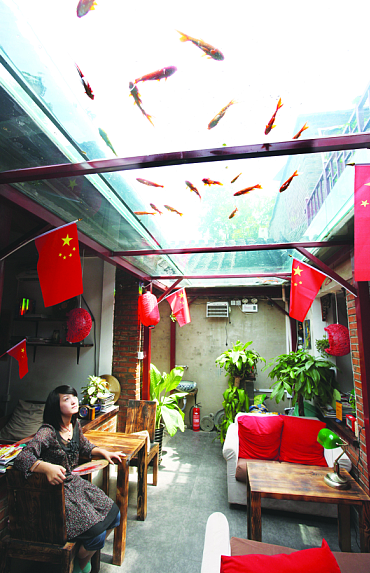 |
Chinese place an feng shui aquarium inside the house or a small pond outside, hoping to increase their chances for wealth and good fortune, because the Chinese word for fish (yu) has the same pronunciation as abundance and affluence.
When it came to feng shui advice the 29-year-old's relatives were quick to voice their views.
"They believe a house with auspicious feng shui will bring the inhabitants positive qi (energy), which will improve our health and facilitate a happy married life, otherwise, our good luck would be taken away by some ominous qi," he says.
There has been long debate about feng shui in China. Critics say it is merely superstition but Huang doesn't care. He'll get as much help he can as he pursues a better life and good fortune, and he is not alone.
China's top real estate and home furnishing website, soufun.com, held a recent online survey among more than 4,000 people and more than 85 percent respondents said they had applied some feng shui practices in their homes.
Expats living in China are also open to new ideas.
"I've been told by my Chinese friends to avoid renting houses facing squarely with broad driveways, or near temples or cemeteries, which are said to impose bad luck on the dwellers due to the violation of feng shui taboos," says Antonio Valli, 27, an Italian freelance journalist in Beijing. "When in Rome, do as Romans do," Valli jokes.
Despite past debates, feng shui is now getting more official credibility after the Ministry of Culture announced in June last year it was considering listing feng shui as a national intangible cultural heritage.
In light of the prevalent trend, some training institutions, colleges and universities are now offering various feng shui courses given by well-known or unknown feng shui masters. The courses are attracting business people, corporate executives and real estate developers from home and even abroad.
"People who used to simply assume feng shui as feudal superstition have began to rediscover the mystery of this age-old geomantic culture, especially the property developers," says Gao Yan, the founder and president of the China Feng Shui Culture Institute based in Beijing.
Since May 2010, as the dean of the newly established Chinese Culture School at the Beijing Economy Management College, she has lectured on environment planning under the guidance of feng shui.
"Property developers began to value feng shui in their construction projects because potential home-buyers are pleased by their products, which they can sell at a good price," Gao explains. She says more people want to see the scientific benefits for feng shui's longevity.
Despite the increased interest, some experts are worried that some training organizations are deliberately overstating fengshui's effects by mystifying it as a supernatural power and are giving people a distorted impression of its true nature.
"Feng shui is not an occult science or superstition, but belongs to the field of construction management," says Yi Bu, the president of International Society of I-Ching Culture.
"It is the soul of city planning and architecture building in ancient China, reflecting our ancestors' understanding of building and space."
"Feng shui is Chinese people's unique wisdom of living and a cultural heritage formed by knowledge and experiences accumulated for thousands of years.
 |
"It is a decision-making tool for people to evaluate the environment, as well as optimizing interpersonal and human-nature relationships, in a bid to achieve an overall harmony."
Yi explains the essence of feng shui is the art of placement and aims to create harmony between a building's interior and exterior architectural spaces.
It involves scientifically balancing the positive and negative ions in the air, in order to keep the people living inside the home healthy.
"Yin and Yang is the most basic concept of Chinese culture. Feng shui helps people to seek the harmony of the two elements, which is the long-sought ideal state for us," he said.
As many Chinese cities continue to clone Western architecture, many more Europeans are embracing the concepts of feng shui.
Some are flying to China to visit historical sites to better understand and appreciate the charm of this eternal Asian cosmology. The Forbidden City is a classic example of feng shui's real-life practice.
More and more feng shui books are being translated into various languages and are unveiling the mystery.
"In some European countries, such as Germany, feng shui consulting has become an emerging industry, some people even try to obtain professional qualifications by completing training courses," says Han Zenglu, a professor at the Beijing University of Civil Engineering Architecture, who also serves as an expert at the China National Architectural Style Art Commission.
He says feng shui theory is a comprehensive and scientific mix of diverse subjects, comprising geography, ecology, landscape, architecture, ethics and aesthetics.
Han says it is unwise for modern Chinese to blindly copy architectural style from the West, while putting aside their own valuable cultural treasury passed down through generations. "The emphasis on preserving traditional Chinese architectural culture does not contradict with learning from their Western counterparts," he says. "The perfect fusion of Chinese and Western structural principles is conducive to design an artistic architecture in a more scientific way."