Love lives on
 |
|
Li Shuo plays Teresa Teng in the new musical Love U, Teresa. Photos Provided to China Daily |
The legend of Teresa Teng is still very much alive and a new musical in the Broadway style helps spread her message of love to a new generation
If I had to name one Chinese musician who had the biggest impact on the 20th century,iwould pick Teresa Teng (1953-1995). When an overseas cover band strikes up a tune to please Chinese tourists,chances are it'll be a Teresa Teng number,with The Moon Represents My Heart among the alltime favorites.
If there is one Chinese singer whose songs yield readily to a musical like Abba's Mamma Mia, that must be Teng.
According to Teng Chang-fu, chairman of the Teresa Teng Foundation, the iconic chanteuse lent her voice to 3,000 songs, 2,700 of which were made into recordings. On the popular music downloading site top100.cn, only 1,192 of them, from 92 albums, are available, and many, I suspect, are duplicates. For one thing, I have never heard her Vietnamese and Indonesian renditions. But growing up in the early 1980s, I'm familiar with much of her repertory.
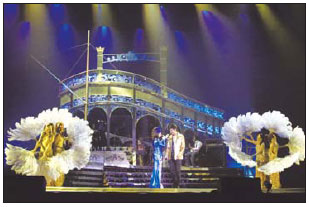
A few of the melodies featured in Love U, Teresa, a new musical that opened on Dec 30 in Hong Kong, were from that era and have rarely resurfaced since then. The young reporters sitting next to me at the trial run in Guangdong early December were puzzled: "Were these Teresa's tunes? I've never heard them before."
You would have to have lived in the Chinese mainland during the late 1970s and early 80s to understand why Teng was epoch-making, though no mainlander ever saw her performing live. For decades we had been clobbered with "revolutionary hymns", fiery slogans about wiping out this and overcoming that. Before her songs wafted across the Taiwan Straits via cassettes, we did not know a song could be about one's love for another, or that words could be caressed with such tender emotions.
Under the circumstances, this kind of singing (instead of shouting) was subversive enough to be banned. The timely appearance of audiocassettes solved that problem. The radio did not play any of her songs until years later, when local cover versions ventured into the less "decadent" territory of her vast canon.
By the time Teng died suddenly from asthma in 1995, China was liberal enough to mourn her openly. News also surfaced that some organization had been trying to get her to perform in the mainland and she took a strong interest as well.
During the early phase of China's reform, there was a saying that people listened to Old Deng (Deng Xiaoping) in the daytime and to Little Deng (Teng is the Taiwan spelling of Deng) at night. She had a billion-plus fans on this side of the Straits, whom she had never met but for whom her singing represented a return to pop music as an expression of human love.
Li Dun is one of these people. "I was hosting a show in Shanghai when someone told me Teresa passed away. I felt my world had crumbled," recalls Li, producer of Love U, Teresa, that was in rehearsal for months before the 10-night run in Hong Kong.
Li is not the first person to attempt to revive her idol, for the stage.
"There have been four or five musicals based on her songs or her life story, but they were essentially concerts with some golden oldies strung together. Mine is the first real musical," he insists.
Li admits he was inspired by Mamma Mia, which has an original plot. He sets his story in current-day Shanghai around a struggling rocker and Teng emerges as a phantom to serve as his muse. The young man has a girlfriend, so any association with the movie Ghost can be deflected.
To tell this story, Li enlisted Wang Hui-ling, scriptwriter of Crouching Tiger, Hidden Dragon and other Ang Lee masterpieces.
"I was wondering why no one ever thought of asking me to write a musical," Wang jokes. It turns out she majored in music and was a huge fan of Teng to start with.
"I knew all of her songs and can hum hundreds of them, complete with lyrics. So, I did not have to thumb through the vast catalogue for the right number for a dramatic situation," Wang tells me before a dress rehearsal.
Wang crammed 32 songs into the show but, with only a few exceptions, did not change the lyrics. She also balanced Teng's work to "align the order of the songs with the narrative framework of the musical".
Many of the songs are re-orchestrated in other styles, including rock. Teng Chang-fu, Teresa's brother, is comfortable with that.
"We respect the creative process. All we asked was no tinkering with Teresa's public persona - a gentle purveyor of love."
Teng's songs can be summarized as mainstream pop with roots in Chinese folk tunes and ditties. Although she made occasional forays into the fads of the day, such as disco, her voice was a divine fit for Chinese love ballads, lowbrow or highbrow.
To give the show a contemporary vibe, Broadway director and choreographer Joey McKneely and musical director Daryl Waters were enlisted, but it was at first hard for them to understand the significance of Teng and her music in the Chinese-speaking world. The result is not a gala-like parade of old chestnuts fit for nostalgia, but a fast-paced romp through her familiar songs, in new but heartwarming situations.
Stage designer Shen Ao was given a tough job. "I wanted to create a feeling of fantasy in which the male lead of the real world connects with Teresa on a spiritual level. I wanted to be close to Broadway in terms of stagecraft," he says.
But the fast scene changes and limited time for integrated rehearsals caused hiccups in the run-through. During some of the sessions, a two-story house that was supposed to collapse on cue would simply not fall as planned.
Fortunately the 8.3 meter-by-13.5 meter LED screen that acts as a backdrop works properly. "It gives us flexibility in shaping the atmosphere for a scene," says Shen, the designer.
Being a stage show, Love U, Teresa has plenty of time to work out the kinks. Li Dun's last musical, Butterflies, ran for 200 performances, and he says he expects his new one to last 10 years.
For that length of time, Li can keep his current cast. Young, energetic and talented, his ensemble tackles singing, dancing and acting with aplomb. For the female lead, Li had an open audition - for someone who not only sings like Teresa but resembles her in appearance as well. About 4-5,000 aspirants showed up, and he picked two. Wang Jing is 18, the youngest of the bunch. "When I heard her, I got goose bumps," recalls Teng Chang-fu. "She crooned just like my young sister, yet she was not imitating."
Teng may never have thought she'd become a lead in a Broadway-style musical. Chang-fu shared an anecdote about her performing in New York in 1980 and catching a few Broadway shows. She was impressed by the high technical and artistic demands. "So, the thought did not materialize that she starred in her own (musical), let alone being the subject of one," Chang-fu says.
But Li Dun the impresario has bigger ambitions. He wants his Teresa-themed act to stand tall in the Chinese-speaking market as a counterweight to Western shows that tour China. More than that, he wants it to break through into the international arena as a quintessential Chinese product with worldwide appeal.
"Teresa's was a language of love," he expounds, "and this can be understood by people everywhere."