Where the gypsies rule
|
Budapest is a city of music, with buskers outside most mass-trasit-rail stations and at pedestrian underpasses. Patrizia Schlosser / DPA |
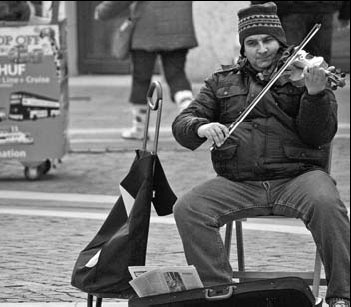
BUDAPEST - In the Hungarian capital Budapest, the vibrant music of local bands rings out from countless bars almost every night of the week.
Welcome to one of the most dynamic live music scenes in Eastern Europe, where ethnic Jewish and gypsy influences combine with tango and flamenco to create an exotic and heady party mixture sometimes tinged with sadness.
Of course there are buskers on almost every street corner in Budapest but the real action is in locations like the Jewish restaurant Spinoza Haz where Judith, a red-haired singer with the group Klesmeresz, is poking her head through the stage curtains.
She gazes briefly at the gathering who are waiting eagerly for the band to appear. Some are attired in elegant evening dress while others are dressed casually.
The seven-piece group springs into action, weaving the sound of fiddles, clarinets, drums and double-bass into neo-klezmer numbers that vary from the euphoric to the downbeat. Devoted audience members are quickly up on their feet and dancing.
"For years there were no klezmer bands left here at all and now a good dozen of them are active," said Richard who plays double-bass with Klesmeresz. The bitter-sweet sounds of this music have their origin in 15th century eastern Europe. Klezmer was the name given to wandering Jewish minstrels.
This expressive music, originally conceived to replicate the human sounds of laughing and crying, has enjoyed a modest renaissance in recent years and not just in Hungary.
A lively klezmer scene has sprung up in the Jewish quarter around the main synagogue in recent years although many houses in the narrow, twisting streets remain empty. The neglected facades of these Art Nouveau buildings stand as silent witnesses to the city's grim past. Cafes and restaurants such as Spinoza Haz stage concerts where Nazi occupying troops once ruled the roost in the city's Jewish ghetto.
Fresh growth has come from the rubble of that dark era and that certainly goes for the Godor Club. Visitors have to descend into this establishment since it is located in the foundations of what was destined to be the country's new national theater. The site was earmarked for that purpose in the 1990s but work never progressed and all that remains is the pit or "godor" in Hungarian which was excavated to accommodate its planned foundations and basement.
Today it is the venue for some of the most popular bands in town, among them the Budapest gypsy combos Amala-Kanchi Dosh and Parno Graszt. The young Romany musicians whip their audience up into a frenzy with accordion, guitars and drums. This is infectious music that gets hands clapping and feet tapping.
The men perform a kind of frenetic shoe-tapping dance, whirling across the floor while the women take tiny steps, twirling their skirts and letting their long, black hair fly.
The band leader whoops into the microphone and the joint begins to jump. A member of the audience starts bounding across the boards until his sweater is soaked with perspiration while another drops to his knees in a theatrical swoop every few minutes, only to leap up again seconds later.
Couples hug each other as they gyrate across the dance floor, mothers jive with their teenage children and leather-jacketed young men with shiny, gelled-back, black hair follow the proceedings closely from the wings.
Just a few meters away from this lively location stands a young man with an electric guitar and a ghetto blaster, bombarding the almost completely deserted pedestrian zone at 11 pm with noise.
Buskers have taken up residence in almost every pedestrian underpass or in the entrances to the city's underground railway stations. At Deak Ferenc ter, an ample, wide-eyed young lady delivers a mournful song.
Naturally the Danube is a popular Budapest carousing venue too. Alongside numerous boat-based restaurants plied by musicians who play for tourist money at the tables, is the A38, a former Ukrainian coastal vessel now used for concerts.
Classical music fans will find plenty to warm their hearts too. At Liszt Ferenc ter square there's a handsome statue of the composer Franz Liszt, just around the corner from the musical academy he helped to found. When the windows are open you can hear the students flexing their fingers at the keyboards.
Hungary's national opera house is not far away either, a splendid neo-Renaissance edifice which dates back to the 19th century. The walls and ceilings inside are covered with thick layers of baroque ornamentation.
Less hallowed and rather more experimental is the light opera house where a bridal dance musical set to klezmer music is regularly performed. The piece revolves around the conflict among the Romanian, Jewish and Hungarian sections of the local populace with a reconciliatory theme. Music is an ideal vehicle for a story like this, especially in a city where the muses evoke so much laughing and crying.
German Press Agency
(China Daily 02/10/2011 page20)