The year of 1.3 billion rabbits
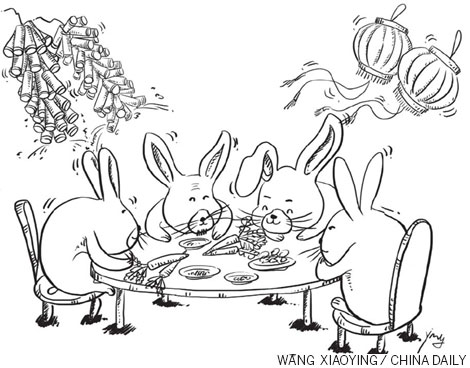
Spring Festival, celebrated by Chinese people all over the world four to six weeks after the Gregorian New Year, distinguishes itself by celebrating not only a new calendar cycle but also the fecundity and life heralded by the start of spring. This epitome of Chinese culture, which celebrates family and abundance, offers the perfect opportunity to reflect on China's progress in the previous year and forecast its coming year.
For a European like myself, the animals associated with the Chinese lunar calendar are not only fun, but provide surprisingly suitable analogies for China's development during the last several years. For me, the just ended Year of the Tiger was a fitting symbol of China's roaring economic progress. Similarly, the Year of the Rabbit adds another dimension to my analysis of China's growth.
I have learned that according to the Chinese zodiac, the rabbit embodies a wide range of personality traits. It is gracious, kind, sensitive, elegant, reserved, tender and lucky, though it can also be moody, detached, opportunistic, and stubborn.
The Chinese conception imbues the rabbit with the full spectrum of its natural temperament, but the Western conception is more limited and thus a more accurate analogy for China. Westerners do not generally consider the individualistic personality of rabbits, but rather their swift movement and strength in numbers as a result of their rapid reproductive ability. Speed and growth are just two traits shared by rabbits and Chinese society.
The Playboy Bunny is perhaps one of the most famous rabbits in the Western world. It is a symbol of sexual liberation and physical indulgence, of male fantasy and correspondingly, femininity in its most exaggerated form. Even though Playboy has been an established brand since the middle of the last century, the Playboy Bunny is still a significant symbol of a once-groundbreaking and boundary pushing institution that has remained relevant and profitable.
The lifestyle glamorized and promoted by the pages of Playboy magazine appeals to many Chinese today. Beyond this level, however, Playboy has a lesson or two to teach China, most importantly its success in synthesizing edgy cultural commentary and mass-market appeal. As China's media continues to multiply and diversify in full force, there is a need for more trailblazing voices to beckon the formation of an engaged, involved public.
To employ another rabbit from the Western world to continue the analogy, we could say that China, the magician, needs to pull more than one rabbit out of its hat. China's growth since the 1990s is nothing short of magic, but the magician should no longer be content with his limited role as a raw supplier and a manufacturer of other countries' designs. He needs to lead the way in innovation, too. When consumers purchase a product emblazed with the phrase "Made in China", they should expect superior quality and smart design, not poor construction and a derivative concept. The magician's rabbits, abundant as they are, ought to be more spectacular as they emerge from the hat.
I have repeatedly commended China for its forward-focused vision but at the same time I have argued that it must develop cultural and social institutions alongside its economy. Given recent trends, today I am even more optimistic about China's ability to perfect a society that is not only wealthy but inspiring to the rest of the world.
China recently stunned the world when students from Shanghai outperformed participants from all other countries in reading, math and science in the Program for International Student Assessment. Although standardized tests are limited in what they indicate, the Shanghai students' success demonstrates the value of China's Confucian-based education model in honing the foundational skills necessary for advanced-level education.
Equipped with study skills to match a solid foundation in math, science, and languages, an increasing number of economically advantaged Chinese students are attending universities in Europe and the United States to earn graduate and postgraduate degrees, often in business. In contrast to Chinese graduates of the last generation, who were generally older and less likely to challenge the status quo, today's Chinese students have a growing voice in the world. They are no longer passive receivers of Western modes of thought. Instead, they are more likely to chart their own courses in life.
These students' worldliness and confidence, afforded to them by China's economic condition, will equip them to find innovative solutions for the world by hybridizing the best of Chinese and Western educations.
Rabbits, with their strength in number and their ability to quickly adapt to changes in a world to which they hold the key, are going to be the agents of change in 2011.
The author is a director of a media company based in Paris.