Bear - the “senior” mascot of China
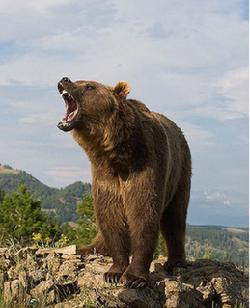
Common characteristics of modern bears include a large body with stocky legs, a long snout, shaggy hair, plantigrade paws with five non-retractile claws, and a short tail.
|
 |
Bears are generally bulky and robust animals with relatively short legs. Bears are sexually dimorphic with regard to size, with the males the larger of the two genders. Larger species tend to show increased levels of sexual dimorphism, and where a species varies in size across its distribution individuals from larger sized areas tend also to vary more.
Unlike other land carnivores, bears are plantigrade, meaning they walk with the full soles of their feet flat on the ground. They distribute their weight toward their hind feet, which makes them look lumbering when they walk. Even so, they are still quite fast—the brown bear can reach up to 30 miles per hour (48 km/h)—though slower than felines and canines. Bears can stand on their hind feet and sit up straight with remarkable balance. Bears have non-retractable claws, which are used for digging, climbing, tearing and catching prey.
People of the Han Dynasty worshipped the bear, a unique cultural phenomenon of that dynasty. Many cute bears with auspicious images can be found on the jade objects, pottery, lacquerwork, bronze equipment, sculptures and bronze mirrors of the the Han Dynasty.
The totem of the ancestor
The three jade bears excavated from the Yin Xu Fuhao Tomb of An Yang of He Nan province are the earliest examples bear artwork known today.
At the end of July of 2010, one of the three jade bears was exhibited at the Capital Museum in an exhibit about archaeological work in China. The jade bear vividly depicted the image of a bear, setting an example for the later works of the the Han Dynasty.
|
 |
There is a long history behind the use of the bear as a totem. In the Shang Dynasty, people used the bird as a totem. After that, the Shu Emperor of the Shang Dynasty made the silkworm his totem. In ancient times, people of the eastern tribes and the Shennong ethnic minorities used dragon as their totem. When the Yan Emperor and Yellow Emperor began to govern the country, they made great contributions to the integration of the ethnic groups. What is more, the Yellow Emperor built his capital at Xinzheng, where had some bears. Therefore, he was also called “You Xiongshi,” meaning “Bear Emperor.”
It was said that the Chinese myth of “Shan Hai ching,” which was deeply loved and praised by Lu Xun, a famous Chinese writer, was written for the Chu people of the Warring States Period. The story begins with a high mountain, called the Bear Mountain. There were many caves in the mountain, where bears lived and the immortals always went there to play with bears. In the summer, the doors of the caves were open, while in winter, the doors of the caves were closed. If the doors of the caves were open in the winter, turmoil and disaster would occur. Therefore, there was some relation between the bear and divinity that could decide the wealth or woe of the common people.
Although it was a myth, people in ancient times believed it, and the bear totem commanded great respect at that time.
It was recorded in the work “Zuo Zhuan” that the Chu Cheng king ate a bear’s paw before he killed himself after he lost a battle. It was also once believed that the oldest ancestor of the Xia ethnic group became a bear after he died. It is therefore clear that people in ancient times showed great favor and respect to the bear.
The people of the the Han Dynasty also respected the bear
The people of the the Han Dynasty continued the folk customs of the Chu dynasty. Therefore, it is certain that the people of the the Han Dynasty loved and respected the bear. Many cultural relics of the the Han Dynasty excavated from tombs like Zeng Hongji and Ma Wangdui involved images of bears. Most of the artistic works delineated a bear’s shape extremely vividly and nicely.