Real China
|
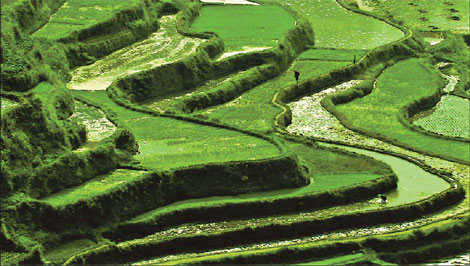
A scene from the six-episode TV documentary series Wild China. Provided to China Daily |
CCTV's new all-documentary channel is an attempt to build nation's image while also giving a boost to local documentary makers. Sun Li reports.
At the beginning of 2011, China's national television station (CCTV) launched a 24-hour, all-documentary channel, broadcasting in both English and Chinese. The channel, CCTV-9, commenced with Wild China, an Emmy-award winning documentary and the first non-fiction program produced jointly by CCTV and BBC, in 2008.
The six-episode, high-definition series explores China's diverse habitat and wildlife, and is filled with fascinating images such as threatened Tibetan antelopes, or chiru, filmed in temperatures of -30 C in Tibet's Chang Tang Nature Reserve, and bumblebee-sized bats living inside a hollow bamboo stem, captured by infrared camera.
Liu Wen, director of CCTV-9 calls Wild China, which has been shown in more than 60 countries around the world, an outstanding example of "building China's image through documentary", adding that this is exactly why the relatively old was selected as the opening program of a brand new channel.
"The documentary channel was launched to create a vivid, multidimensional album of China," Liu says.
Modeled after the United States-based Discovery channel - the world's No 1 non-fiction media with a reach of more than 1.5 billion cumulative subscribers in over 180 countries - CCTV-9 offers compelling cinematography across a range of genres including history, nature, science and technology, and people and places that have shaped the nation.
"Many world-famous documentary channels, including Discovery, are role models for us on how to build the image of a country through non-fictional programming," Liu says.
"Documentaries have proven to be effective in enhancing a country's cultural influence."
A 2010 CCTV survey of overseas markets showed that non-fictional programs are more readily accepted than TV series in foreign markets, according to one report in the People's Daily.
The survey mentions the one-hour China Time program, shown on Germany's NRWTV, that presents a variety of CCTV-produced documentaries on art, food, health and lifestyles in China. "In CCTV-9, we now have a powerful and exclusive platform to present diverse Chinese documentaries," says Professor Hu Zhifeng of the Communication University of China. "Having a dedicated documentary channel is a proactive step in strengthening the presentation of China's image."
But to Liu Wen, CCTV-9 is more than a platform for presenting documentaries.
"The channel also acts as an incubator for locally-produced documentaries and is a boost for China's documentary industry," he says.
"A good documentary must combine artistry and commercial appeal and should stand the test of the international market."
In recent years, a number of outstanding documentaries that have won domestic and international recognition have been made by CCTV producers and filmmakers.
Most of these talented producers are now part of the team of the documentary channel, including Zhou Yan, vice-director of CCTV-9 and one of the executive producers of such hits as The Rise of the Great Powers (2006), Road to Revival (2007) and The Power of Corporations (2009).
The team also includes those who have collaborated with their foreign peers, gaining valuable experience through such cooperation.
"Some colleagues who co-produced Wild China with BBC have recounted with amazement how they once saw the BBC crew wait for a whole month for the perfect shot," Liu says.
That valuable lessons were learned is evident in the 2005 CCTV documentary The Forbidden City, in which more than 200 scholars and experts from around the world were involved to ensure its authenticity.
"We hope to bring the same level of expertise to our forthcoming documentaries, that are rooted in China but have a global appeal," Liu says.
He says, half the programs shown on CCTV-9 are bought from provincial TV stations and independent documentary filmmakers.
The purchase of 1,400 hours of programming every year will make the channel the biggest buyer of non-fiction programming in the Chinese television business, and give a big boost to the nation's fledgling documentary industry.
Liu points out that the main challenge facing documentary filmmakers is the lack of a market. This restricts the number of documentaries produced.
Most programs now available are of mediocre quality as TV stations generally ignore non-fiction programming.
"With CCTV-9 stepping in to fill the demand void, and the soaring ratings for our programs, we have been receiving a large number of tapes sent by provincial and municipal TV stations," Liu says. "We are showing that non-fiction programming can be lucrative."
Besides creating the market, the documentary channel will also help establish training programs to cultivate more talents in the documentary film business.