50 centuries later
By Zhang Kun (China Daily)
Updated: 2011-03-06 07:49
 |
Large Medium Small |
|
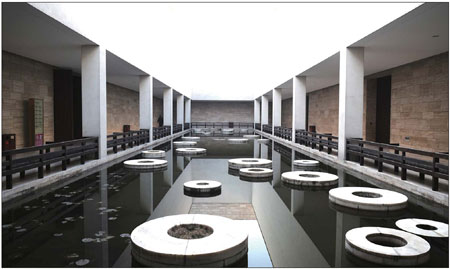
The giant 'matchbox' Liangzhu Museum, by London-based architect David Chipperfield, is a 9,500-square-meter project sitting among the bamboo plants and lotus ponds. [Photo/China Daily] |
|
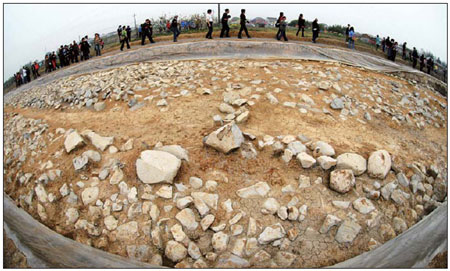
The archeological sites are well-preserved to reveal the remains of ancient walls. [Photo/China Daily] |
A new park shows visitors how China's people lived before men learned to write. Zhang Kun explores
A weekend trip to Liangzhu, in suburban Hangzhou's Yuhang district, will not only take you to blooming orchids and green countryside, but also 5,000 years back to China's primitive civilization.
It was before the age of written records, but jade items scattered all over the hillsides and villages tell of the life and culture in the Yangtze Delta at that time, especially around the lower range of Taihu Lake.
On March 8 the Liangzhu National Heritage Park will officially open to the public. Visitors can see ancient stone walls, archeological sites and the Liangzhu Museum, where scenes of daily life have been reconstructed.
"Building the heritage park will bring new life to the archeological site," said Shan Jixiang, director of the State Administration of Cultural Heritage. "This has proved to be a very effective channel protecting our cultural heritage."
At first he was against the idea of building a park on the archeological site, believing it would result in damage and destruction to the relics, but he changed his mind when seeing the building plan: The core archeological site will be completely protected - nothing will be built, no trees will be cut down, and no changes will be made.
At one of the first archeological sites, orchids, pears and peaches are being grown and visitors are welcome to come and smell the flowers. It was first dug in the 1930s when Liangzhu was discovered as home to the 5,000-year-old civilization. Later the excavation expanded to a wider area.
The excavation in Liangzhu began more than 80 years ago. In the latter half of the 20th century, some important tombs were discovered on the hills in the area, and large numbers of jade items were found. There are all kinds of remnants of the Neolithic Yangtze River delta people - handiwork artifacts of jade, silk ivory, lacquer and black-burnished pottery.
In the 1990s, rock mining was the biggest business in Liangzhu. But the noise, dust and destruction of the mountain posed serious threat to the environment. By 2002 the local government had all the mines shut down, re-directed a main highway out of one of the archeological sites at Mojiaoshan, and started a long-term project to restore the natural beauty of Liangzhu.
They removed the factories and relocated the farmers' homes, cleaning the site to reveal the remains of an ancient wall and other relics.
"The widest part of the wall stretches more than 100 meters - nobody knows why the wall should be so broad, but it's solid proof of a highly developed civilization that existed here 5,000 years ago," Qi Jinhai, a public relations officer for the Yuhang district, where Liangzhu is located, told China Daily.
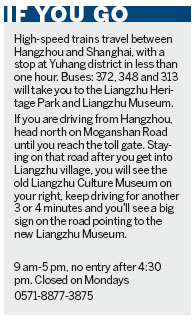
The park stretches over an area of 25 square kilometers, about three times the footprint of the Imperial Palace in Beijing, said Wu Liwei, deputy director of the Liangzhu Heritage Administration Committee. "In the future we'll have an electricity-powered shuttle bus service in the park, and a cycle route as well."
Around the park, local cuisine will be served in restaurants hosted by farmers who live nearby, and folk art and craft experience zone will allow visitors to experience the lifestyle of the distant past.
Recently a canoe was unearthed in Liangzhu. It's the largest and most complete prehistoric canoe ever excavated in China. "This area used to have a network of waterways. Water ran in the blood of the primitive people," Wu said. "Now we'll restore the waterways, and place the park carefully within, like a beautiful island."
Now grasslands, shrubs and these manmade waterways surround the core area of the park. Eventually, visitors will be able to take a boat ride, just as people then used to do, Wu said. Rare animals will be introduced - including cranes, peacocks and deer - to add life to the park.
The first phase of the development for the heritage park has cost 600 million yuan ($91.27 million) and the most important part has gone to the Liangzhu Museum, a 9,500-square-meter project, created by London-based architect David Chipperfield.
The building looks like a giant matchbox sitting among the bamboo plants and lotus ponds. Stepping inside, you'll find that the architect divided the exhibition spaces into four smaller spaces, with five courtyards inserted amid them. The courtyards let in daylight and soften the rectilinear stone passageways.
The museum presents how Liangzhu was discovered and the history of excavation in the past 80 years. Some important caves where very precious objects were found are represented in the museum. Multi media technology brings scenes vividly back to life from - 5,000 years ago - people farming with plows with stone tips, craftsmen making pottery and jade, women weaving cloth and silk.
Even though there is no written record, the patterns and drawings on pottery and jade provide solid proof of a highly developed civilization. One of the four exhibition halls will stage temporary shows from other museums, most for no more than two months, according to the museum.
(China Daily 03/06/2011 page16)
| 分享按鈕 |