Stars in his eyes
|
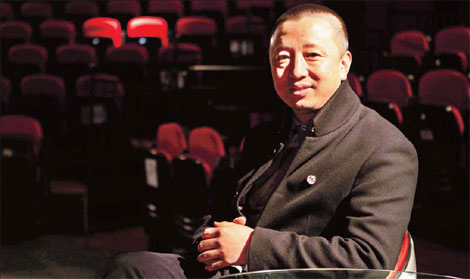
Fan Xing, 40, founder of Star Theater wants independent theaters in Beijing to become must-go places for tourists. Photos by Wang Jing / China Daily |
|
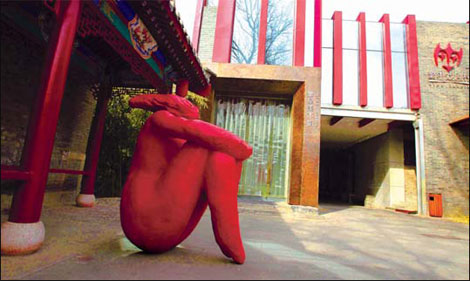
Star Theater, which aims to develop into a cultural village. |
Fan Xing hopes to provide more choice for the city's theater lovers. Han Bingbin reports.
Star Theater, a new hub for drama fans, is the first of its kind in the capital. The innovative spirit of the theatre is in stark contrast to the traditional cultural establishment in central Beijing. It has five rooms that cater to different dramatic needs, along with a gallery, a reading room and several bars and restaurant, and it aims to become a real cultural village as it expands.
When work started on the Star Theater compound at the end of 2009, Beijing had no more than 10 independently run theaters staging dramas performed and created by young artists.
Fan Xing, 40, founder of the Star Theater (in Chinese the venue carries his name), calls such independent theaters "an experiment".
In the late 1990s, he abandoned his international delivery business in his hometown in Shandong province to move to Beijing to start a new business with his friends, investing in television dramas.
While others said he was crazy, Fan said that having majored in Chinese literature at college, television drama was obviously a better choice in terms of his knowledge base, let alone his passion for drama, which he inherited from his father.
"If it wasn't for family interference my father would have ended up as a drama student at the Chinese Central Academy of Drama. He was already admitted by the school before he was forced to choose another school and college instead," he said.
"I grew up with books written by Shakespeare and Chekhov."
"I think everyone has a heart wanting to act. Our life is filled with moments of acting, isn't it?" he said.
Fan said he wished he'd had a chance to act on stage, but life placed him on another track. Moving into the drama business seems the closest he will come to his teenage dream. But even that has taken considerable courage and risk.
Fan and his friends have invested in eight television dramas over the past decade, including one that was a hit on China Central Television in the late 1990s.
But Fan said his most significant achievement in the past decade was the art school he took over in 1998. He came to know that school when many of its students served as extras in the TV dramas he produced.
It was managing that school that finally encouraged him to make his theater village dream a reality.
"About 20 percent of the art school graduates can further study at art colleges, and among these only 20 percent will stay in acting. But because Beijing has a limited number of theaters, many of these people will end up drifting among different troupes playing very small roles. They can barely survive in the city," he said.
"My first aim is to provide these young actors with more opportunities."

That ideal has prompted Star Theater to create what they call "theater and production combined". Unlike traditional State-owned theater houses, small theaters in Beijing don't have a production team; instead, they only provide the space.
Star Theater has around 16 signed actors and a young production team including directors and script writers. Apart from making actors feel at home, that system has granted Fan more control of content.
"I am definitely more interested in creating content instead of providing space," he said.
In the past year, Star Theater has produced more than 700 shows, most of which are produced by the theater itself. Fan said his criteria for selecting a script are simple: it should be innovative in terms of subject and form, have audience interaction and have realistic significance.
"But I refuse anything too sexy, violent and depressing. I like to see enlightening moments come in a warm way," he said.
His approach seems to be paying off as the audiences are growing.
"At the beginning, the seating rate was no more than 10 percent. Now it is around 70 percent at the busiest time," he said.
However, the theater is still operating at a loss and Fan is looking to appeal to a broader audience. He is considering cooperating with outside directors.
"People in the industry should really cooperate to improve the whole business."
But he said that vicious competition among small theaters has impeded their development.
Fan says that Star Theater is unable to compete with the national theater houses, which put on big promotions for television. So, Fan is looking for more government support.
"The Xicheng district has offered us some financial support after we came first in an annual evaluation of small theaters. I'm trying to encourage the local tourism bureau to promote theaters as a major tourist destination," he said.
"I hope in the future theaters in Beijing will become must-go places for tourists."
(China Daily 03/07/2011)