Music for the ears, balm for the soul
|
Performers stage a group dance in the gala show Songs of Guangxi. Wang Xiaojing / for China Daily |
|
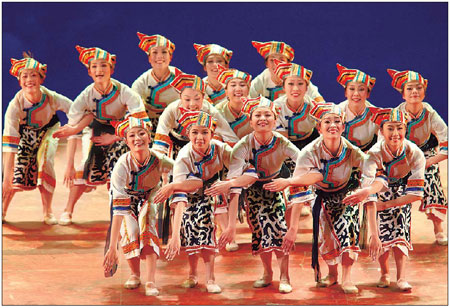
Director Zhang Jigang with the show's performers on the stage. Wang Xiaojing / for China Daily |

If the fastest way to a man's heart is through his stomach, the fastest way to the heart of a Chinese place could well be through a stage show. Many ordinary people across the world got a glimpse of China from the Opening Ceremony of the 2008 Beijing Olympics. Likewise, many provinces in China have their own versions of singing and dancing extravaganzas that attempt to capture the beauty and essence of these locales. They invariably showcase the local culture ?especially folk songs and ethnic customs ?by condensing the fecundity and diversity into a two-hour glitz of sights and sounds.
You can credit Guangxi officials for foresight in hiring Zhang Jigang, a member of the formidable Olympic triumvirate, years before he became a household name, first with the dance number Thousand-Hand Bodhisattva and then the Olympics. That was 2002. By April 5, 2003, Songs of Guangxi had premiered. Since then, it has toured some 20 provinces for 426 performances.
On March 1, it debuted in Beijing's National Center for the Performing Arts, aka the national theater. Zhang Jigang was in the audience. When he stepped on the stage at the end of the show, he was given the longest ovation.
Zhang had conceived the production as "sculpting people's image with people's language". By "people", he was referring to the five major ethnic minorities in Guangxi Zhuang autonomous region, namely Zhuang, Miao, Yao, Dong and Jing.
The production is neither a drama nor a variety show, but somewhere inbetween. It has the fluidity of a 3-D movie, combining music, dance, scenery and multimedia projections. In terms of content, it is divided evenly into two parts, with the first half called Labor and the second Love. A harvest dance foreshadows what was to come in the Olympic Closing Ceremony, with rows of grain spikes and ears glowing in the setting sun and farmers shuffling in and out as if in a game of hide and seek.
In other numbers, farm tools such as hoes and shoulder poles are featured prominently, conjuring up an idyllic tableau of man's perfect harmony with nature.
Zhang wanted to preserve as much of Guangxi's ethnic authenticity as possible. One duet features "curses" between a man and a woman, which camouflage their mutual attraction and is a practice fast fading in this age of direct communication. Another dance sheds light on the surreptitious movements outside a bridal chamber on the wedding night, where friends attempt to steal a peek at the newlyweds' most intimate moments. It may go against the modern concept of privacy, but it is quaintly touching as theater and a heart-warming reminder of an ancient but vanishing lifestyle.
China's ethnic minorities are known for their colorful costumes, as well as singing and dancing. This pageant is color coded for those who cannot tell one group from the other: The Zhuang is dressed in black, the Dong in purple, the Miao blue, the Yao red and the Jing white. The finale for each of the two parts comes with a burst of bright gold and other colors in a dizzying carnival of celebration.
The show has over 1,000 costumes and 400 ornaments. With 168 in the cast and crew, each performer has to go through multiple costume changes, some in barely 30 seconds. But more technically demanding is the rotating stage of three parts, with an outer peripheral moving on its own. Weighing 3 tons, it measures 14 meters in diameter and has a sloping shape. It needs a 9-meter trailer to be transported. Yet, the crew had only 24 hours to set it up so that performers could rehearse on the stage of the national theater.
For those not into the magic of stagecraft, Songs of Guangxi has plenty to offer in music. As its name implies, there is an abundance of singing. The show harbors the ambition of attaining the status of a predecessor, a musical from the 1950s titled Third Sister Liu (Liu Sanjie). Using picturesque Guilin as the backdrop, this tale, enshrined in a 1960 film adaptation, has become a classic.
Creators of the new show want people to know that Guangxi has more folk music, compared to that in Liu Sanjie. Ever since the project was conceived, a cadre of musicians was sent to cull the land for melodies. As many as 60 tunes were discovered, out of which half have made it into the show. "These ethnic groups use singing as verbal expression. On many occasions, singing takes the place of speaking," says Ye Miaozhuang, vice-president of Liuzhou Art Theater, the production company behind the show, and also an acting director.
Performers were not selected by ethnicity. They came from different backgrounds and had to learn numbers from other ethnicities. "In the process, we have become a big family," Ye says. "Many have retired, and new members have joined."
For the Beijing tour, 54-year-old Liang Zhijian, who retired in 2010, came back to sing his "Curse" song. An actress caught up in the frantic rehearsal, did not find out about her pregnancy until the company embarked on the journey to Beijing. Yang Guangchun, yet another performer, could be an exception. She was an ethnic Dong singing at a local tourist attraction. Now she sings in the Dong chorus, which has a complicated vocal structure, yet singers like her have an intuitive grasp without formal music training.
In another nod to the Beijing Olympics, a young girl stands out in the spotlight in the large cast. Yuan Kexin, 10, is the youngest of the cast, and the Beijing tour marked her second time with the show. She was accompanied by her father and told that if she did well he would take her to such iconic places as Tian'anmen, the Great Wall and the Forbidden City.
Nothing can beat the sensation of climbing the Great Wall and walking through the imperial palace, not even an Olympic-size spectacle. Likewise, a visit to Guangxi would be an unrivalled and unforgettable experience. Failing that, check out Songs of Guangxi.
A better way, though, is to cap a visit with this musical fete.
(China Daily 03/09/2011 page18)