Chinese learning like getting in shape: no pain, no gain
A foreigner hoping to learn Chinese is like a person with a flabby physique hoping to get in shape.
The process is tough and it's difficult to start and easy to backslide.
In the same way the out-of-shape wish the pounds would evaporate without crunches and calorie tallies, language learners imagine fluency without sweating through hundreds of hours of classes and homework.
While I've yet to find the athletic routine to forge my pudgy parts into sinew, I have discovered a one-size-fits-all regimen that will put some muscle behind any foreigner's Mandarin - HSK training.
Training for the HSK (the National Chinese Proficiency Test, aka Hanyu Shuiping Kaoshi) is arguably the best way for a foreigner to whip their language skills into shape.
But, like retracting a beer gut into a six-pack, it's not easy.
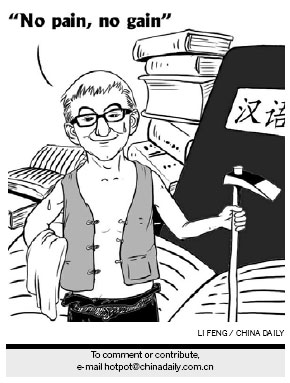
It requires sticking to an expert-devised diet of vocabulary and an intensive regiment of grammar drills, listening exercises and character writing.
Part of the advantage of the HSK is its systematically tiered structure.
Since the HSK was reformed in November 2009, it comprises six levels with a required vocabulary that doubles per tier. Passing Level 1 requires recognition of 150 characters, while getting through Level 6 requires knowing 4,800.
The beauty of this, on the study end, is that the list for every level is standardized and published. So passing Level 3 was largely a matter of being able to read and write the 600 characters on the official sheet.
So, the essentials of each tier are also the building blocks of that level of practical proficiency.
This is unlike the TOEFL or old HSK, in which examinees might have any word in the language thrown at them.
Students are not learning - as I had while studying for the old HSK - words like "irregular polygon", "android" and "angioplasty" before they know how to say, let alone write, "hate", "respect" and "flat".
It provides a standardized, step-by-step language-mastery method I've yet to see elsewhere. Throughout the training, you learn what you should learn next, next.
But the HSK's listening comprehension and grammar sections get tougher at every level, too.
For the Level 3 listening comprehension section, simple statements are read slowly and repeated before a pause during which examinees can answer. Think, "The nurses should have been ready at 2 pm for the operation at 4 pm. Question: When should the hospital employees have finished preparations?"
But for Level 4, the sentences are read once, rapidly and without pause: "The surgery starts at 4. The doctor was supposed to arrive an hour early but ended up being a half an hour later than he should have been, which was an hour and a half later than the nurses were scheduled to have completed the final phase of preparations. Question: By what time were the nurses scheduled to finish prepping?"
Read at top speed, such questions would leave most non-Mensa members scratching their heads if asked in their mother tongues.
But if you know the words well enough to pass the HSK, you know them well enough to pass the tests of real life.
While there are no shortcuts to learning Chinese, there are a few things I've found add momentum.
Getting iPod touch apps that allowed me to look up words based on writing the characters, or typing in the pinyin or English, used alongside flashcards, increased my absorption rate by about 80 percent.
And using Chinese when I didn't have to, and didn't want to, proved the "no pain, no gain" theory.
I swore off movies, outings, guitar - pretty much everything - until I passed. Friends joked my wife had killed me, hid the body and was sending SMSs from my phone.
But perhaps the biggest difference came from a resolution to never cancel a lesson because I didn't feel like doing one.
Getting in physical shape is about getting off your duff, no matter how much you don't want to. But, as the HSK regiment proves, not getting out of your chair - no matter how much you want to - is the best way to firm up your Chinese.
China Daily
(China Daily 03/10/2011 page20)