Classic Love Stories from China
People, regardless of their culture and where they live, are always affected by sad, sentimental love stories. Each February, especially around Valentine's Day (February 14), romance fills the air. There's no better time to reflect on classic Chinese love stories.
 |
Butterfly Lovers
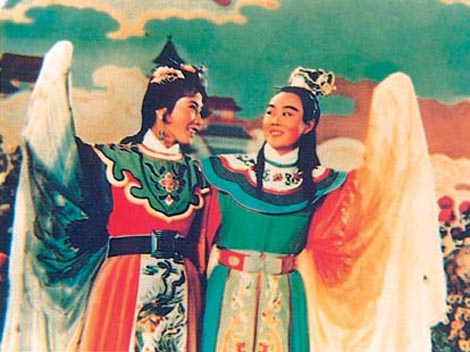
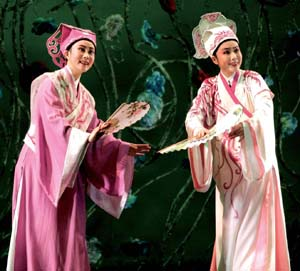
The Butterfly Lovers, or Liang Zhu, is a Chinese legend about the tragic romance involving Liang Shanbo and Zhu Yingtai. The legend is considered the Chinese equivalent to Romeo and Juliet, the tragedy written by English poet and playwright William Shakespeare, who is widely regarded to be the greatest English writer and the world's preeminent dramatist.
During the Eastern Jin Dynasty (AD 317-420), according to legend, there was a beautiful, intelligent young woman named Zhu Yingtai. She was from Shangyu, in East China's Zhejiang Province, and she was the ninth child, and only daughter, of a wealthy family.
At that time, girls were not allowed to attend school. However, Zhu persuaded her parents to let her disguise herself as a young man, so she could travel to Hangzhou to study. During her journey, she met Liang Shanbo, a scholar from Kuaiji (now known as Shaoxing), in the same province. As they felt like they had been lifelong friends, they took a vow of brotherhood.
During their three years of studies, they shared a room, which had one bed and two quilts. Liang, a bookworm, failed to notice that Zhu was a woman.
 |
After the three years had passed, they said goodbye to their teacher, and each other, and returned to their hometowns. But Zhu and Liang missed each other. Several months later, Liang went to visit Zhu. To his surprise, he saw that Zhu was a woman. They became passionate lovers, and they vowed, if they could not live together, they would die together.
A short time later, Liang sent a matchmaker to Zhu's home to ask for permission to marry their daughter. However, the elderly couple had accepted a proposal from Ma Wencai, the son of a rich family in the neighborhood. The news stung Liang. The brokenhearted young man fell critically ill — and died.
On the day Zhu was supposed to marry Ma, strong winds prevented the wedding procession from escorting Zhu beyond Liang's tomb. Zhu left the procession to pay her respects. She cried in front of the tomb. Suddenly, the tomb, hit by lightning, opened. Without hesitation, the young woman leapt into the grave. As the rain passed, and as the sky cleared, Zhu and Liang's spirits turned into a pair of beautiful butterflies. Joyfully, they flew together among the flowers. They were never apart again.
For thousands of years, people have been moved by that beautiful love story. In 2004, six of China's cities (Ningbo, Hangzhou and Shaoxing, in Zhejiang Province; Yixing, in Jiangsu Province; Jining, in Shandong Province; and Runan, in Henan Province) collaborated on the formal application to have the legend proclaimed a masterpiece of oral and intangible heritage of humanity through the United Nations Educational, Scientific and Cultural Organization (UNESCO).
In 2006, the application was handed off to UNESCO, which sanctioned the legend as an official cultural legacy of China.
'Swan Song' of Beauty
During the reign of Emperor Wanli, of the Ming Dynasty (1368-1644), Beijing, the capital of China, was prosperous and at peace. Brothels were busy. The Yicuiyuan brothel was the most popular, because of its star courtesan, Du Shiniang.
Du was born into an official's family. When she was 10, her father, County Magistrate Du, was accused of taking bribes from the suspect in a case. Du died in jail. After his death, Du was sold to Yicuiyuan. She was a beautiful girl, a great singer and a graceful dancer, and, as a result, she quickly became the most popular courtesan in Beijing.
However, she never showed affection to anyone until she met a young scholar, named Li Jia, from Zhejiang. Li arrived in Beijing to further his studies and prepare for the imperial civil examinations. One day, he wandered into Yicuiyuan, where he met Du. She admired Li, and thought of him as a reliable man. Li, in turn, was captivated by Du's beauty. They started to live together, in the brothel, as husband and wife.
Li's parents ordered him to return home after they learned he had taken up with a courtesan. He refused. His parents disowned him and cut off his inheritance.
Du negotiated with Ye Cha, the madam of Yicuiyuan, and managed to buy back her freedom for 300 taels (390 ounces) of silver.
After Du and Li had moved out of the brothel, they rented a boat. They planned to leave for Li's hometown, and they vowed their love was undying. Du sang on the boat.
A wealthy playboy, named Sun Fu, was on a nearby boat. Du's singing caught his attention, but her beauty caught his fancy. He had never seen such a beautiful woman. He wanted Du, and he persuaded Li to sell her. Du was devastated when she learned about the transaction.
The next morning, Du did her hair and makeup. She remained silent until after Li had handed her over to Sun, for 1,000 taels (1,300 ounces) of gold. Slowly, she opened a chest that contained jewelry worth considerably more than 100,000 taels (130,000 ounces) of gold!
According to legend, Du said to Li: "I hid my wealth in the chest, as I wanted to see if you loved me truly. I meant to use it when we started our family. How you disappointed me! After a few coaxing words you sold me to someone you didn't even know! Do you still remember our pledges? Everyone here is a witness. You betrayed me!" After saying her piece, she threw the chest into the river. Then she drowned herself.
For thousands of years, people have admired Du for her strong character. They have also sighed, with great sorrow, about the tragic way her life ended.