Crazy stone
An iconic cultural symbol is more popular than ever
Gold has a price, but jade is priceless, goes an old Chinese saying. But last year jade did have a price, which rose nearly 30 percent, according to the Gems & Jewelry Trade Association of China (GJTAC). While the value of other gemstones fluctuate, the price of jade in China continues to rise year after year, making it one of the least affected commodities during any economic downturn.
|
A jade collector in Zhejiang province displays a jade mirror from the Han Dynasty (206 BC- AD 220). The price of jade rose by 30 percent in 2010. Pan Lianggan / for China Daily |
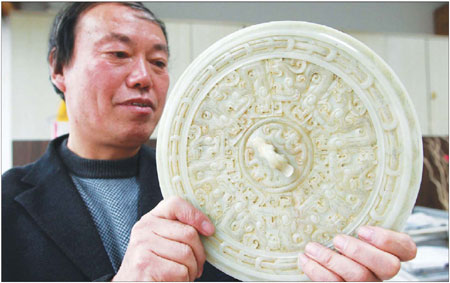
A jade collector in Zhejiang province displays a jade mirror from the Han Dynasty (206 BC- AD 220). The price of jade rose by 30 percent in 2010. Pan Lianggan / for China Daily
And at auction houses, jade always attracts major investors. Last year an imperial white jade seal fetched 8.8 million euros at a Hong Kong auction, smashing the world records for both white jade and imperial seal that ever went under the hammer.
The imperial jewel was inscribed Tai Shang Huang Di or "Supreme Majesty", referring to its user, the late Qianlong emperor (1711- 1799) of the Qing Dynasty (1636 -1911), China's last feudal kingdom.
But jade is not simply a piece of fine decorative stone for the Chinese people. It is also a noble gem of high aesthetic value and has been worshipped in the Middle Kingdom for more than 7,000 years and continues to be a symbol synonymous with Chinese culture.
It is one of the most popular items tourists buy when visiting China and even played a gold medal role in Beijing Olympic Games.
The medals awarded to the world's best athletes in 2008 incorporated polished jade, which featured the pattern of a dragon.
"The Chinese believe that jade is a treasure bestowed to the human world by heaven," says Yan Zengfeng, a jewelry expert with GJTAC. "They think each piece of jade absorbs nature's essence that has developed over millions of years."
"Because of the toughness and unique texture, jade becomes an eternal symbol of China's magnificent civilization, and it has long been regarded as a stone that symbolizes beauty, nobility and virtue, which is an embodiment of traditional Chinese values of ethics and honor.
"It is often said that if a person wears jade, such as a bracelet, for a long time it would suck away the bad spirits from the wearer, making the person healthier, and the jade itself will become more lustrous, glossy and transparent."
Belief in the healing powers of the gemstone is not only a Chinese concept but was also shared by Europeans in the 16th century.
The English word jade is derived (via French l'ejade and Latin ilia) from the Spanish term piedra de ijada, which was first recorded in the mid-1500s. It means "loin stone" because of its reputed ability to cure ailments of the loins and kidneys.
No matter what powers jade may have, the mystery, legend and romance surrounding it and its status as China's most prized precious stone continues to create demand.
"Collecting jade stones is an investment that can be expensive at first but over time can earn you big bucks, because the value of jade increases fast," says Fu Yongkuan, 54, an antique and art collector in Beijing. He has collected jade items for 15 years and says now is the time to buy.
"The price of a piece of jade art I bought from a friend several years ago has now at least tripled," Fu says, adding that the skyrocketing price of jade has driven more speculators to cash in on the craze.
In addition to individual investors, some institutional investors have also eyed the niche market convinced of its appreciation potential.
"Although jade collection is profitable, it is vital for buyers to have some appreciation to avoid buying sham pieces," says Song Yong, the sales manager of the jade stone department of artxun.com, China's largest online art collection marketplace.
Song says his company's special jade online store opened in April last year and after a slow start, there has been major sales growth.
"In the first month we were only selling less than five inexpensive jade sculptors, but after running for a while, the monthly sales volume has reached more than 100 pieces," Song says.
He says the scarcity of jade resources and the rising costs of labor, transportation and processing have all contributed to the higher prices, making him very optimistic about the prospects of domestic jade market.
But some experts worry that the boom in jade investment may lead to the over-exploitation of jade ore and the destruction of the environment.
"Jade is a scarce and non-renewable resource, which is a great wealth left by nature," says Bai Miao, the deputy secretary general of the jade culture committee of the China National Light Industry Council.
"But instead of preserving and making good use of this rare resource, some local governments are in blind pursuit of temporary economic interests by randomly digging up the jade ore and selling them at low prices.
"This is not only a huge waste, but also severely damages the local ecological balance."
To halt the environmental destruction, the Chinese government recently instituted reforms to regulate jade mining. It now prohibits commercial digging along forests and riverbanks.
In 2006, the central government banned jade mining in Northwest China's Xinjiang Uygur autonomous region, a major jade producing area famous for the Hotan jade, which is a rare variety noted for its whiteness and flawlessness.
Bai says before the ban, the mining leases were only 6,000 yuan (658.27 euros) for 0.067 acre of land and miners could dig as deep as they wanted. The result was serious losses of water and soil erosion, as well as the speeding up the desertification.
"It's good news that government is taking measures to protect jade but I expect more to come."
"As an important and irreplaceable carrier of Chinese culture, the preservation of jade is in fact the preservation of Chinese civilization. We must leave some wealth to future generations."