Movie magic ambassador
Promoting Chinese films has become a lifelong passion for a Belgian massage therapist. Fu Jing reports.
 |
|
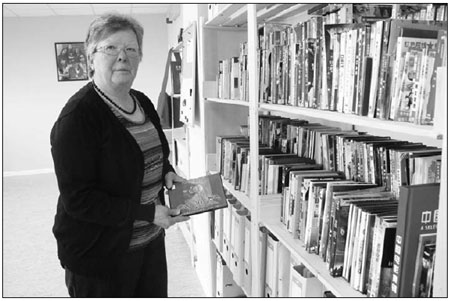
Brigitte de la Royere works at the Royal Belgium Film Archive, which has a collection of more than 2,500 Chinese films. Fu Jing / China Daily |
Brigitte de la Royere was once grabbed by film star Siqin Gaowa and literally dragged away, all the while chatting away in her native Mongolian language. When Siqin finally realized Royere wasn't responding to her words, she looked up and realized she had grabbed the wrong person.
That rather strange encounter was the start of a close friendship between Siqin and Royere, a 64-year-old Belgian massage therapist. Moreover, the incident added to Royere's growing love for Chinese films and culture - something that began shortly after China's opening up in 1978.
That passion for Chinese films has resulted in Royere becoming the unofficial curator of more than 2,500 Chinese films, numerous movie posters and documents at the Royal Belgium Film Archive, in Brussels.
The films and items have come from the Chinese Embassy, her personal collection and donations from the daughter of a late friend, Regis Bergeron, a French connoisseur of Chinese cinema.
Every week for three half days, Royere is at the archive, talking to moviegoers, researchers and students interested in Chinese film studies.
"This is not work but pleasure," Royere says. "Watching films and discovering things are not hard work."
Every week, she sends out newsletters and updates the archive's website to announce the latest movies. Last month, she invited cinemagoers to watch a new film, Let the Bullets Fly, directed by her friend, the director and actor Jiang Wen.
"Even if there is just one person asking to watch a Chinese film in my office, I will accompany that person here," Royere says.
Ironically, Royere, who became interested in China and its culture when she was very young, never even thought of visiting China until she met two "normal" Europeans who were among the first people from Europe to visit the country after it opened up in 1978.
She uses the word "normal" because before opening up, only businessmen and those from the Belgium Communist Party could visit China. "They were 'normal' because they had no business or political connection to their visits," she says.
At that time, Royere had just graduated from university and was working as a therapist. She was told it was easy to visit China as the country had just opened its door and expected more overseas visitors.
"I immediately bought a ticket and joined a group of Europeans," says Royere, adding that she was likely among the second group of "normal" Europeans to visit China.
On Sept 28, 1978, Royere began her trip to China, visiting Beijing, Hong Kong, Xi'an, Nanjing and even a model village called Dazhai, in Shanxi province. The visit was a culture shock as both Europeans and Chinese were "eager and curious" to know each other.
As Europeans, they were used to recognizing a person's social status and background by the way they dressed. But this was impossible to do in China then as nearly everyone dressed in the same style and colors. "That was interesting," Royere says.
For her, 1978 was like the moment the Chinese people awoke after 10 years of the "cultural revolution" (1966-1976). The Europeans met students who had just returned from "being re-educated" in the countryside, who were urgently cramming with knowledge. "They shared some interesting stories," Royere says.
Shortly after returning to Brussels, she linked up with the Belgium-China Association and obtained permission to watch some Chinese films, which were kept in a storage room. But she soon discovered it was more interesting to watch the films with other fans.
By the early 1980s, with more foreigners visiting China, she invited them to share their experiences of China by showing slides to members of the association. Increasing numbers of foreigners were keen to share what they had experienced and learnt, and Royere was instrumental in organizing such activities for five years.
Royere also learnt the Chinese Embassy in Brussels had many films, most of which were not cataloged. With the help of a friend, she spent two years cataloging the films, which included at least 400 feature movies.
"That was a really good way to learn about Chinese culture," she says, adding that she was reading Chinese film magazines at the same time.
At the same time, promoting Chinese films was her hobby, and many of the films were kept at her home. It wasn't until last year that the archive started to keep her collection.
"I am quite relieved that these treasures have finally a safe place, with the proper temperature, humidity and light," she says.
Because of her love of Chinese culture, Royere tried to learn Chinese but after studying for a year and a half, she couldn't cope with working at a hospital, archiving the films and learning the language. "It was too much," she says.
Over the years, Royere has been a frequent traveler to China. These visits have fleshed out Royere's interest in China, which stems from her childhood. She used to read a lot of books by foreigners who lived in China in the early 1930s or 1940s. Among them was Elizabeth Comber, the daughter of a Chinese engineer and a Belgian woman, whose books revealed China to Royere.
Royere says Comber studied medical sciences, as she did. And Comber also knew Belgium. "She is very close to my culture and so she is my favorite writer on China," Royere says.
Through her visits, Royere has come to realize that one great way of learning Chinese culture is by watching its films. "The language speaks, but the images speak more," she says.