Retiree weaves new career with knots
 |
|
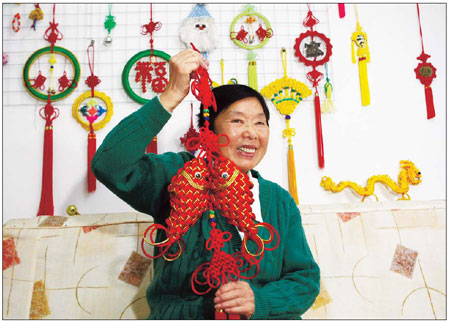
Knot master Liu Liming, 72, with examples of her work. The retired teacher says it takes three to four years to become proficient in the art. Photos by Zou Hong / China Daily |
Few people can claim to be as tied up in their pastime as 72-year-old Liu Liming whose love of Chinese knots has bound her to a craft that has been listed as part of the nation's intangible cultural heritage for the past 20 years.
When METRO met Liu in the workshop at her home in Dongcheng district, she was knitting the legs of a pig.
The knots she uses are made from silk thread and have been popular in China since the Zhou Dynasty (c. 11th century-256 BC), when rich people and noble families started using knots as ornaments combined with jade. The skill did not spread among ordinary people until the Qing Dynasty (1644-1911).
Liu started to learn the techniques 20 years ago after she retired from her job as an English teacher and is now an expert.
In her home, she has decorated a wall with her works, such as a fan and basket, and 3D fish and a dragon.
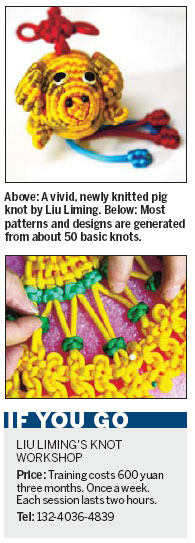
Liu said there are about 20 basic knots and others that have evolved from them. Generated from about 50 knots are hundreds of patterns and designs.
"The basic knots may seem simple but some people can only tie one 2D knot while others can come up with a 3D dragon boat using that same knot. That's how you can tell a master from a beginner," she told METRO.
Having encountered many detours in her own progress, Liu has a lot to say about the teaching of Chinese knots.
She said learning about them from books instead of from a teacher is not a smart choice because many of the books have made the process and the formula so complicated that students may become confused and unable to learn even the basic knots.
"Without some basic knowledge of the knots, students may not even understand the graphical presentations in the books," she said. "One of my students learned from books for a year but she can't even weave the most fundamental knot without reading the books."
She explained her point by demonstrating how to tie the panchang knot, the most important and fundamental knot in the craft - something that took half an hour.
The tools required are simple and cheap: a piece of plastic board, which you can get from packages of household appliances, a pair of tweezers, 20 beading needles, and lots of silk thread.
Silk thread is fixed onto the plastic board using the needles and Liu moves the silk thread into the right position using the tweezers.
This process is far easier to understand in person than it is by trying to follow it in a book. The next step is often completely missing from the books.
After removing all the beading needles from the board, the knot already has the look of a proper knot but is a lot looser. The next step is to pull the threads following their original order to make the knot tight.
"Half of the key technique is in this process, which is impossible to be shown in a book," said Liu. "Even if you understand the patterns, the finished items won't look good if you don't know how to pull the threads to tighten the work."
Liu said the capital used to attract Chinese knot masters from around the country before 2000. But when a flood hit the warehouse that stored most of the silk thread from Yiwu, Zhejiang province, craftsmen in the city were forced to think about relocating.
"Then SARS invaded the city and most of the good practitioners left," said Liu.
She said the situation improved during the 2008 Olympic Games, but the number of people who still practice the craft is a lot fewer than it used to be.
"Chinese knots are relatively easy to learn compared to other traditional crafts such as Beijing liaoqi and kite-making because it only takes three to four years to become skillful," said Liu. "But still, most of those doing it are older than 50.
"People, especially the young, are all busy making money to pay off their housing loans. Few turn their attention toward traditional crafts."
She said the big pair of fish she made that hang on the wall in her workshop took more than a week to finish and might only sell for 60 yuan.
Today, she shares her workshop with three other Chinese knot craftsmen and they hold lessons once a week.
"I hope more young people will come to the workshop to learn this skill, which is not only traditional but also practical," she said.
"In places like Taiwan and Hong Kong, where Chinese knots are flourishing, people even make furniture out of them."