Delicacies
Why the world should eat Chinese
By Pauline D Loh (China Daily)
Updated: 2011-05-16 17:22
 |
Large Medium Small |
Mothers know best, and the Chinese mother it seems, knows even better than most on what to feed her family. Pauline D Loh looks at some new food rules based on old adages.
Eat food. Eat food that mainly comes from plants, not those made in plants. Eat food that your great-grandmother can recognize and name.
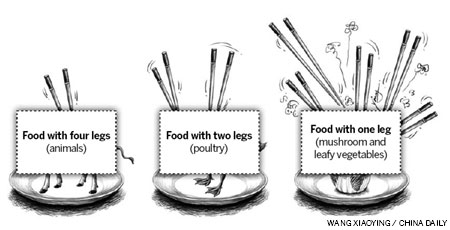
Food with one leg (mushroom and leafy vegetables) is better than food with two legs (poultry), which is again better than food with four legs (animals).
And finally, if you have to eat animals, make sure they are happy, free-range creatures that did not suffer in life.
These are a few of the 64 rules set out in Michael Pollan's book Food Rules: An Eater's Manual - guidelines curated from a collection of old and new adages gleaned from mothers, grandmothers and even old wives' tales which he calls "repositories of conventional wisdom" distilled from many people and many places.
Pollan puts his finger on the pulse on a growing concern worldwide, and he pokes at an extremely sore spot. Every day, from London to Washington to Beijing, television and radio programs invite experts of every caliber to tell us which foods are good for us, which are not, what nutrients are lacking, what supplements to take.
It has contributed to a confused and befuddled generation of eaters who no longer know what to eat, how to eat or even when to eat.
Marketing has become a complicated expedition, where the average housewife has to memorize by heart all the food that is good for a) her growing children, b) her husband with potential diabetic, heart or hypertension problems and c) her ageing parents who need food that can improve their memory and slow down bone loss.
Pollan pares it down to just seven words. Eat food. Mostly plants. Not too much.
What he is really saying is: Go back to a simpler age when food came from the land, vegetables were harvested with roots that had clumps of earth still clinging to them and the killing of an animal was a festive occasion.
The preparation of food should only include two steps: cleaning and cutting, cooking and seasoning. There should be no chemical additives, preservatives or coloring and certainly no ingredient added that you cannot pronounce or is not normally found in your pantry - like high-fructose corn syrup, xanthan gum, ammonium sulphate or ethoxylated diglycerides.
Eat food, Pollan says, that will eventually rot. Real food is supposed to go bad when bacteria in the air start making their presence felt, and if it is too well-preserved, immortal food should join the mummies - the Egyptian kind, not the maternal species.
It all makes an awful lot of sense, especially against the background of increasing concern about the quality and healthiness of processed food, especially in China.
When Pollan goes on to the next section, the fog clears more, and a comforting calm descends. As he describes what and how we should eat, it begins to read like a page out of a Chinese cookbook.
Eat vegetables, mostly leaves, he says, and use meat more as a flavoring. That's the basic formula of a Chinese stir-fry.
He suggests drinking the water the vegetables has been cooked in, exactly like the rapid-boiled Chinese vegetable soup in our daily menus.
Treat meat as a special occasion food, he says, and the bell chimes once again. Peking duck, roast lamb or crispy spring chicken have always been regarded as dishes for special occasions.
When Pollan borrows from the Chinese proverb on the one leg, two legs and four legs theory, there is no longer any doubt.
Chinese cooking - the down-home, rustic cuisine - is one of the healthiest diets in the world.
All we need to do is to go back to the kitchen wisdom of our great-grandmothers and grandmothers. Most of our mothers may have already deviated from the course.
In spite of all the pharmaceutical, nutritional information overload, getting back to the basics is still the best.
Eating food that is grown within 10 kilometers of where you live, traditional cooking methods practiced by our ancestors and the prudent if parsimonious use of meat and oil are all part of the big secret.
When we skip the fast food, ignore the processed food and go back to eating natural foods, that's when we can wave goodbye to all the urban ills such as obesity, clogged arteries, diabetes, hypertension and heart disease.
Eat lots of vegetables in stir-fries, flavored with a little meat. Eat colored vegetables that advertise the presence of their beneficial phytochemicals in bright green, red, yellow and orange.
We should "eat some foods that has been pre-digested by bacteria or fungi", such as miso, soya sauce, kimchi and sourdough. Chinese diets already include three out of the four.
Another Pollan guideline has found resonance in China's major cities - grow your own food, even if it's just a balcony garden.
Learn to cook. And, eat less. The Chinese has always believed you should eat until you are only 70 percent full, qifen bao (), and Pollan quotes that adage.
It is time to pay attention to what our grandmothers say.