Modern mystery meets present history
|
 |
|
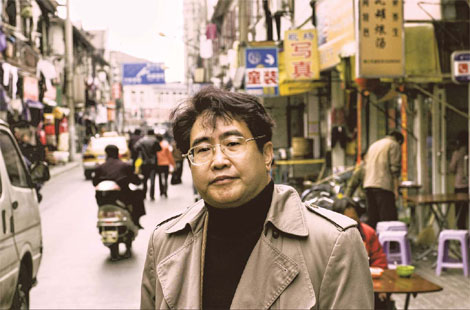
US-based mystery writer Qiu Xiaolong often visits his hometown, Shanghai, whose rapid development is a theme of his works.[Photo/China Daily]? |
A detective writer strives to show the changing social realities of the times in his whodunit storylines. Zhang Kun reports.
Qiu Xiaolong sat down to write a poem about the country's rapid transformation and ended up authoring a mystery novel set in contemporary Shanghai.
The poet and translator, who lives in the United States, found great success with his first attempt at fiction, a genre into which he dove in the 1990s.
His 2001 English-language Death of a Red Heroine won the best novel category of the Anthony Award, a prestigious prize for mystery writers. The exploits of the protagonist, Inspector Chen Cao, have gone on to span six books.
The 58-year-old lives with his wife and daughter in Missouri but visits his hometown, Shanghai, once or twice a year.
He appears as the archetypical Shanghainese man, speaking in a low voice and smiling broadly.

Qiu took a break from Inspector Chen's adventures for a while to tell other stories about Shanghai.
The product of this sabbatical is Years of Red Dust: Stories of Shanghai (2010), a collection of interrelated short stories set in downtown Shanghai's Red Dust Lane.
It took Qiu some time to convince his publishers to risk publishing a book without a mystery to solve. He says it was even tougher to sell them on a short story collection. But the book, first published in French and German, has already sold a quarter million copies.
Qiu did a documentary for a German TV station after the book's publication. He brought a production team to Red Dust Lane, which was close to his childhood home and was where he would hang out after school as a youth.
He is planning to write three collections chronicling the lives of Red Dust Lane's residents, he tells China Daily.
"My primary goal was to talk about Shanghai's rapidly changing society and the people swept away by it," he says.
Certainly, the road to success that has led Qiu back to Red Dust Lane has been a bumpy one.
Upon high school graduation, he was sent to the countryside for "re-education", as were millions of youth during the "cultural revolution"(1966-76).
He spent four years working in a clothing factory that produced workers' uniforms, gloves and hats. Qiu spent his free time reading and studying English alone.
His efforts paid off in 1978, when he passed the national university entrance exam and enrolled in the Beijing International Studies University.
He completed his post-graduate education under poet and translator Bian Zhilin at the Chinese Academy of Social Sciences.
Qiu went to the United States to further study writing in the late 1980s.
But he wasn't sure how to construct his stories when he began writing fiction a decade later.
"I decided to write a detective story, because there was a ready structure for that genre: A murder happens, and a detective arrives at the scene and solves the mystery," he says.
"I thought it would be easy to include what I wanted to say. I didn't know what I had written belonged to the mystery genre. I gave it to the publisher and let them categorize it."
His first book, Death of a Red Heroine, is about the murder of a young woman and national model worker, who lives a double life and is involved in a relationship with a high-ranking Party cadre's son.
The Guardian newspaper ranked it No 1 on its list of the top 10 Asian crime novels. The Wall Street Journal named it as one of the best five political novels of all time.
Following the success of Red Heroine, Qiu took Inspector Chen on many more adventures in Loyal Character Dancer, When Red Is Black, A Case of Two Cities, The Mao Case and Red Mandarin Dress. Qiu has been contracted to write three more books about the detective.
"I always try to present the social environment behind the murder and explore one particular issue in each book," he says.
The series' seventh book, which is scheduled for release in October, is about the pollution of Jiangsu province's Taihu Lake.
"It's not only the water that gets polluted but also people's minds," he says.
Qiu is working with Howard French, a journalist and associate professor with Columbia University, on a book about "disappearing Shanghai". French took pictures of the changing city's scenes and Qiu wrote short poems to go with the photos.
Qiu says he is using an "interactive inspirational" creative process for the book, which he hopes will become "a nice coffee table book - easy and intimate".
The three novels of Qiu's that have been translated into Chinese haven't received the acclaim they have in the West. Many young Chinese readers accuse him of including too much social background - so much so, that it dilutes the mystery's suspense.
"While I had felt a little guilty for my Chinese readers, now I don't feel the least bit of guilt," Qiu says.
"I had to record a period of history."