All that glitters is silver
 |
|
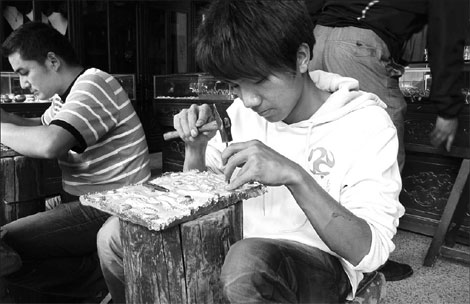
Young craftsmen produce silver items in Xinhua village, in the Dali Bai autonomous prefecture, Yunnan province. [Photo/China Daily] |
 |
|
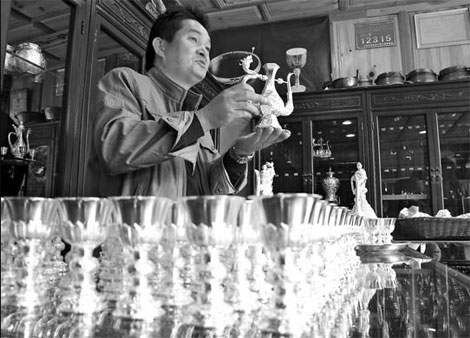
Liu Liangcai shows silver items in his store in Xinhua village.[Photo/China Daily] |
It's boom time for a small village of 1,200 families in Yunnan province, thanks to its skilled noble metal craftsmen. Yang Wanli and Li Yingqing report.
Xinhua is a small village of just 1,200 families, located in the Dali Bai autonomous prefecture, Yunnan province, but it is known nationwide, thanks to a 1,200-year-old history of exquisite silver craftsmanship.
Despite being blessed with great mountain springs, the beautiful village has seen an exodus of its famed silversmiths.
They are much sought after as far away as Fujian province in East China and Gansu province in Northwest China. They are even renowned in Qinghai province and the Tibet autonomous region, where silver items are common and are used extensively in religious rituals.
Before the 1990s, one would have been hard pressed to find a single villager with a high school education.
"They all went outside the province to earn money. After all, it was easier to get rich with their silver handicraft rather than by reading books," Cun Zhongtang, director of the culture bureau of Heqing county, says.
And their wives would accompany them, as Xinhua women are particularly adept at this craft.
Children would be left behind with grandparents, with the parents sending money home at the end of each year.
Xinhua was renowned as the richest village in Heqing county in the 1980s. Families would often post notices advertising how much money their family members had earned. Figures of 10,000 yuan ($1,540) a year - a very big sum for those times - were often quoted.
At least 800 of the villages' 1,200 families are engaged in the ancient craft. Forty-nine-year-old Cun Fabiao, who was awarded the title "Master of Folk Arts" by UNESCO in 2003, is Xinhua's most famous silver craftsman.
Cun was born to a family of silversmiths who served the Ming (1368-1644) and Qing (1644-1911) courts. The sixth-generation descendant of this illustrious family made the oven and hammer - the tools of his trade - a part of his life when he was just 16.
In 1987, Cun went to Tibet and spent two months hammering out a replica of the Potala Palace, which was selected as a gift to the United States by a visiting Chinese delegation.
His success encouraged more Xinhua silversmiths to pour into Tibet, and they soon began dominating Tibet's silver goods market as well as the handicrafts trade with border countries. However, all items carried the "Tibet" rather than "Xinhua" tag.
"This depressed me," Cun says. In 1993, he returned to his hometown and set up his own factory, Biaoxiang. Four years later, his design of a silver wine jug and cups marked with nine dragons received national-level patent certification.
In 2005, the village opened the nation's first silver items museum. Covering an area of about 10,000 square meters, it has a collection of more than 2,000 silver handicrafts created from the Tang (AD 618-907) and Song (960-1279) dynasties to the present.
Xinhua welcomed more than 1 million tourists last year. As tourism flourished, so did Cun's business.
By the end of 2010, Biaoxiang had established five branches in Sichuan and Yunnan, to bring in an income of 5 to 6 million yuan per month. Cun says colleges in Shanghai and Hong Kong are even planning to send students to the factory to study the ancient skill.
Many of the village's silversmiths are now the proud owners of their own business.
Liu Liangcai, 41, has three branches of his store - in Jiangsu province, Shenzhen and Lijiang, Yunnan province.
Like many of his peers, he too picked up the skill when he was 15 and left Xinhua at 26. During his time away from home, he earned about 200,000 yuan ($30,640) a year. But the rapid development of the silver handicrafts industry at home lured him back.
"I returned in the 1990s and now earn about 200,000 to 300,000 yuan every year. My income may have improved only slightly but my job (as a store owner) leaves me less tired," he says.
Nearly 90 percent of Xinhua's silversmiths now have their own stores. The booming market is also providing more jobs to young people in nearby villages.
Yang Jizhong, who works for Liu, comes from Taiping village. Although the 28-year-old earns about 3,000 yuan a month, he does not want his children to follow in his footsteps. "I regret dropping out of school." he says. "I was too young to understand the importance of education."
His 5-year-old daughter is ready for primary school next year. "I hope she receives higher education. Even if she wants to be in this industry when she grows up, I hope she will become a designer and not a silversmith," he says.