A missionary zeal for art
Updated: 2011-08-31 10:25
By Cheng Anqi (China Daily)
|
|||||||||


Every week we look at a work of art or a cultural relic that puts the spotlight on China's heritage.
During the Qing Dynasty (1636-1911), many missionaries came to China, and some of them were masters of Western art, especially of portraits and landscapes.
One of them was the Italian Giuseppe Castiglione (1688-1766), a disciplined and hardworking artist, appointed to the Qing court when he was 27.

He served as court painter for more than 50 years and took the Chinese name Lang Shining.
Working alongside Chinese painters, Lang succeeded in modifying European painting techniques by discarding projection and diminishing the contrast between light and shade while retaining three-dimensional effects and perspective.
Deer Hunting Patrol, housed in the Palace Museum, is one such example.
The painting on silk, about 319 cm long and 268 cm wide, records a deer hunt at Mulan hunting paddock in 1741 attended by Emperor Qianlong (1711-1799).
The third rider at the head of the cavalcade, astride a white horse and with a red case carrying his bow by his side, is the emperor, who was then 30 years old.
A number of ministers accompanied him. Most of them, like Laibao at the head of the procession, the then minister in charge of the royal household, were older than him, while a dozen others, including Fuheng, a bodyguard, were somewhat younger.
Thirty-three years after the hunt, Qianlong wrote a poem to accompany the painting, relating how it had been done by Lang on his orders after he hunted in Mulan for the first time.
He was grieved to note that both men (Laibao and Fuheng) attending the hunt were dead.
The figures of the emperor and other important personages accord with the rules of Western portraiture.
Paintings of the men and horses are obviously based on real life, for there is close attention to detail as well as a strong sense of solidity.
Even as the contrast between light and shade is less distinct, the use of hills and trees as backdrop accords with the principles of traditional Chinese painting.
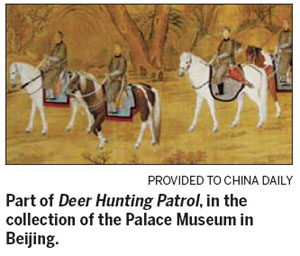
The cavalcade on the move is vividly painted and the size of figures and objects, in the correct proportion to their relative distances, lends a sense of depth to the composition.
"Emperor Qianlong greatly appreciated Lang's style but, at the same time, he didn't want to abandon traditional Chinese painting style. So he asked Lang to work alongside Chinese painters," says Tang Jianjun, an expert from China Academy of Chinese Poetry, Calligraphy, and Painting.
Lang worked with Chinese painter Tang Dai on Deer Hunting Patrol. Lang painted the emperor and the main figures while Tang took charge of the hills and trees in the background.
Located about 450 km northeast of Beijing, the paddock, or hunting ground, was then covered with grass and was full of wildlife, especially deer.
Every year, the emperor, along with his retinue of princes, ministers and members of different ethnic groups, would go hunting there for about 40 days to escape the heat of Beijing.
Before the hunt, horns were blown, in imitation of the sound of the deer, to lure them out of the forest.
The painting depicts the hunting party entering the paddock.