Tibetan plateau may be woolly rhino's evolutionary cradle
Updated: 2011-09-05 14:11
By Wang Ru (China Daily)
|
|||||||||


 |
|
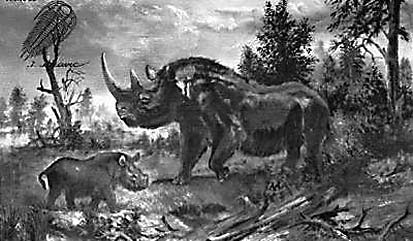
An early painting showing the woolly rhinoceros with young. |
New research suggests the Qinghai-Tibet Plateau's frosty highlands may have been an evolutionary cradle for the woolly rhinoceros and other giant shaggy mammals during the last ice age.
The study, published in Friday's Science magazine, suggests that before the Pliocene epoch's middle era - about 3.7 million years ago - the woolly rhinoceros and other giant mammals adapted to extreme winters on the Qinghai-Tibet Plateau and then migrated to other parts of the world.
The findings seem to undermine the theory that the woolly rhinoceros originated in the Arctic Circle.
The discoveries were made by a group of international scientists, led by Deng Tao and Wang Xiaoming with the Institute of Vertebrate Paleontology and Paleoanthropology under the Chinese Academy of Sciences.
After researching fossils unearthed on the Qinghai-Tibet Plateau, including the recently discovered rhino species Coelodonta thibetana, scientists suggested the ferociously cold winters in the area fostered the evolutionary environment for ice age survival for such mammals as the woolly rhinoceros and mammoths.
Thin air and harsh winters are challenges faced by all Himalayan animals. The Tibetan yak (Bos mutus), with its shaggy wool, is the most charismatic surviving example of special adaptations to extreme cold on the plateau.
The fossils found in the Zhada Basin in southwestern Tibet's Ngari prefecture include a skull, a mandible and a neck bone from the same adult Coelodonta thibetana. They possess features typical of the woolly rhinoceros, such as long skulls, ossified septums and developed teeth plates.
Adult woolly rhinoceroses were 3.7 meters long and two-three tons on average, but they could probably grow to as large as 4.4 meters.
The creature's physical appearance is known from ice age caves drawings discovered in France and mummified woolly rhinos found in Siberia.
The skull of Coelodonta thibetana shows the giant grazer could sweep away snow to find vegetation with its heavy horn. This species' horn is larger than any other woolly rhinoceros', including the Coelodonta nihowanensis of North China and Coelodonta tologoijensis of Siberia. The last known Coelodonta went extinct about 10,000 years ago.
The research suggests the woolly rhinoceros may not be the only mammal that originated on the Qinghai-Tibet Plateau.
The ancestors of the Himalayan blue sheep (Pseudois nayaur), yak and agrili mountain sheep (Ovis ammon) resemble such North American creatures as the bison and bighorn sheep. It remains unknown why the woolly rhinoceros seems to have not made it to North America.
The excavation in the Zhada Basin started in 2006 and was led by the Chinese Academy of Sciences' institute of vertebrate paleontology and paleoanthropology. Many fossils were unearthed, including those of the Himalayan blue sheep, various species of the Mimomys rodent genus and the hunting hyena (Chasmaporthetes).