Comments()
  Print
Print  Mail
Mail  Large Medium Small
分享按鈕
0
Large Medium Small
分享按鈕
0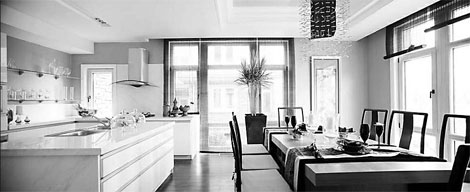 |
|
Modern designs feature open kitchens, which allow for greater family interactions. Photos provided to China Daily |
Today's Chinese kitchens show the dramatic advancement in living standards. Gan Tian reports.
Retiree Li Suying's most vivid memories of the family kitchen back in the 1960s are of black and smoke. The 58-year-old from Hengyang, Hunan province, recalls the bundles of wood stacked in a corner of the 2-3 square meter room, which her father would chop every morning. The walls, pots, bamboo chopsticks and bowls would always be covered in a layer of soot from the burning wood. Basic condiments, such as sugar, salt and soy sauce, were kept in earthen bottles that always felt sticky and oily to the touch. Rice was stored in a giant jar placed in the bedroom to guard against theft.
One of the biggest changes to Chinese kitchens came in the 1970s with the introduction of the pressure cooker. But it was not until the 1980s that good kitchenware began to appear on store shelves.
Su Ming, 34, from Wuhu, Anhui province, says the sum of his mother's kitchen supplies in the 1980s was a large chopping block, pots of various sizes, wooden chopsticks and porcelain bowls and dishes.
In 2004, when Su graduated and moved to Beijing, he rented a small apartment whose kitchen's simple microwave oven was a life saver, allowing the bachelor to heat leftovers, takeaway pizzas and noodles.
After he got married in 2008, he moved to a larger apartment in southwestern Beijing. His kitchen now had not only a microwave oven, but came equipped with an exhaust fan, flat pans, stainless steel pots, and knives and forks.
Li's kitchen has also transformed dramatically. Her vinegar, sugar and salt are now stored in small glass bottles that come with cap dispensers and she is learning how to use a flat pan to make pizzas.
This makeover of Chinese kitchens mirrors the astonishing change in Chinese society, says Ma Lifeng, general manager of Zwilling J.A. Henckels (Shanghai), a leading German kitchenware label.
"People's growing demand for high-quality kitchenware reflects the rapid advancement in living standards. More Chinese people are going in for not only luxury clothes and watches, but also good cooking tools to make their lives better," Ma says.
The progress is best dramatized in a Chinese kitchen's knives. Li says in the 1960s and 1970s, housewives would make do with one all-purpose knife.
In the 1990s, Su's mother had three knives in the kitchen: One for raw meat, one for vegetables and one for everything else.
Su's wife, however, has a set of seven knives. Besides the basic three knives used in Chinese kitchens, there are also a bread knife, a small one to cut cheese, one for cakes and one for fruits.
The popularity of fusion kitchens has given rise to specialty stores geared specifically to their needs. Hong Kong's leading cookware label Pantry Magic now has stores in Beijing, Shanghai and Shenzhen, which offer a range of colorful pots, pans, turners, scrapers and stainless steel fittings, to suit every type of Chinese kitchen.
Tableware, too, has become more colorful. Gone are the days of plain white porcelain bowls and plates. Today's plates, bowls, serving bowls and spoons come in a mind-boggling range of colors and designs.
Chinese tableware designer Wang Yang has created a popular plate with the yin-and-yang pattern. Another plate, based on the Forbidden City pattern, won an award in an international tableware design competition.
Besides chopsticks, Chinese kitchens now also have knives and forks. A growing appreciation of wine has brought a variety of wine glasses in the market.
Last but not the least, the kitchen, instead of the living room, has become the center of a Chinese apartment. "We used to see a closed off kitchen area, but now more families favor an open kitchen," Zwilling's Ma says.
The open kitchen, which segues into the dining area, allows for greater family interactions. Although this idea has been around for more than three decades in the West, it is very new to Chinese society.
"Westerners like to spend much time around the dining table with family and friends, and more Chinese are now taking to this idea," Ma says.
Take Su, the businessman from Anhui. He spends at least three hours at the dining table with his parents and son on weekends, while his wife prepares the meals. He calls it the best time of his life.
Copyright 1995 - 2010 . All rights reserved. The content (including but not limited to text, photo, multimedia information, etc) published in this site belongs to China Daily Information Co (CDIC). Without written authorization from CDIC, such content shall not be republished or used in any form. Note: Browsers with 1024*768 or higher resolution are suggested for this site.
License for publishing multimedia online 0108263 Registration Number: 20100000002731