Veteran ink artist's mountain of work on display
Updated: 2011-09-08 16:00
By Zhu Linyong (China Daily)
|
|||||||||


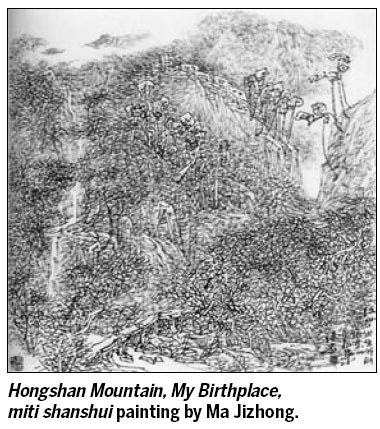
Mountains are clearly close to ink artist Ma Jizhong's heart.
The native of Shaanxi province, which is home to the Qinling Range, says, "I spent my youthful years in mountainous areas, and mountains have become the fountain of my artistic inspiration. Actually, mountains are the refuge of my soul."
He was speaking at the opening of his exhibition that runs through Sept 12 at the National Art Museum of China in Beijing.
Ma's five-decade oeuvre includes caricature, New Year pictures, ink figure paintings, and picture-story illustrations.
But he is best known for miti shanshui (dense landscapes), a less popular genre of Chinese ink landscape paintings, that emerged in the Tang Dynasty (AD 618-907) and reached its height in the Yuan Dynasty, thanks to master painter Wang Meng (1301-1385).
"The creation of a piece of miti shanshui is not only time-consuming but also technically demanding," explains Xue Yongnian, art critic with the Central Academy of Fine Arts.
A typical miti shanshui work often, if not always, is a well-proportioned composition on a huge rice paper scroll. Deftness in Chinese calligraphy is a prerequisite for a miti shanshui painter as the lines, dots and patches of the landscapes are all rendered in calligraphy style. Any completed miti shanshui piece must be done with great care to detail and the overall look should be such that whether viewed from afar or up-close, the painting retains its vivid look, Xue says.
This explains why very few modern painters go down this path, Xue says, pointing out that Huang Qiuyuan (1914-1979), Zhang Ding (1917-2010) and Yang Shanshen (1913-2004) were among the few courageous ones who did.
"My decades-long experience of living and working in the mountains of my home province has convinced me that this genre best suits the natural beauty of the mountains of northern China," explains the 70-year-old.
Born into a Catholic family in Feicheng, Shandong province, in 1941, Ma had a tumultuous childhood, defined by wars, natural disasters and abrupt family changes.
"My mother married three times just to keep her five kids alive amid a time of chaos," recalls Ma, who moved to Xi'an in the late 1940s where his early interest in painting was encouraged by his primary and middle school teachers.
Ma was first trained in basic Western painting techniques at Xi'an Fine Art Academy from 1958 to 1962. In 1969, he moved to the mountainous areas of Taibai county and worked for the next two decades in a culture center where he trained himself in ink art.
In late 1988, Ma moved back to Xi'an where his unique painting style attracted critical attention.
Although Ma lives in the city, he continues to be drawn to the mountains.
"I feel an invisible bond with the mountains the lush trees, the chirping birds, the gurgling springs, and the simple but healthy life of the local residents, all gladden my heart.
"I will paint the mountains all my life."